150 posters, 16 sessions, 294 authors, 70 institutions
ePostersLive by SciGen Technologies S.A. All rights reserved.
Obstetric Anaesthesia Annual Scientific Meeting 2024
Thursday 9 - Friday 10 May 2024, Birmingham

6272915
Current trends in Cell Salvage use for Caesarean Deliveries- When? Why? Why not?
Poster Presenter
Authors
Affiliations
Part of Topic
Current Trends in Cell Salvage use for Caesarean Deliveries- When? Why? Why Not
Introduction:
The aim was to assess the current practice in cell salvage use in MOH and determine whether there are any specific barriers to use.
Methods:
-Observational cohort study and survey to anaesthetists over a 4 month period (July-November 2023).
-Caesarean deliveries with an estimated blood loss above 1 litre included.
-Patient characteristics and trends in autogenic and allogenic blood transfusions studied.
-Concurrent survey to determine whether the MOH was anticipated or not in the anaesthetist’s opinion and whether they encountered any specific barriers to not utilising ICS.
Results:
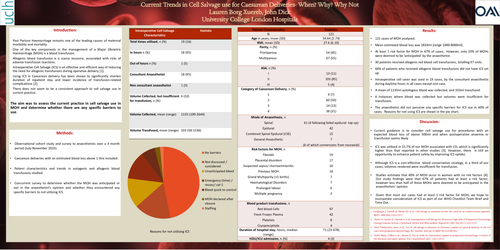
-121 cases of MOH analysed.
-Mean estimated blood loss was 1833ml (range 1000-8000ml).
-At least 1 risk factor for MOH in 67% of cases;. However, only 33% of MOHs were deemed to be ‘anticipated’ by the anaesthetist.
-30 patients received allogenic red blood cell transfusions, totalling 97 units.
-66% of patients who received allogenic blood transfusions did not have ICS set up.
-Intraoperative cell saver was used in 19 cases, by the consultant anaesthetist during daytime hours in all cases except one case.
-A mean of 1135ml autologous blood was collected, and 333ml transfused
-6 instances where blood was collected but volumes were insufficient for transfusion.
-The anaesthetist did not perceive any specific barriers for ICS use in 60% of cases. Reasons for not using ICS are shown in the pie chart.
Discussion:
-Current guidance is to consider cell salvage use for procedures with an expected blood loss of above 500ml and when postoperative anaemia or transfusion seems likely
-ICS was utilised in 15.7% of our MOH associated with CD, which is significantly higher than that reported in other studies [3]. However, there is still an opportunity to enhance patient safety by improving ICS uptake.
-Although ICS is a cost-effective blood conservation strategy, in a third of our cases, volumes rendered were insufficient for transfusion.
-Studies estimate that 40% of MOH occur in women with no risk factors [4]. Our study findings were that 67% of patients had at least a risk factor, however less than half of these MOHs were deemed to be anticipated in the anaesthetists’ opinion.
-Given that most our cases had at least 1 risk factor for MOH, we hope to incorporate consideration of ICS as part of our WHO Checklist Team Brief and Time Out.