150 posters, 16 sessions, 294 authors, 70 institutions
ePostersLive by SciGen Technologies S.A. All rights reserved.
Obstetric Anaesthesia Annual Scientific Meeting 2024
Thursday 9 - Friday 10 May 2024, Birmingham

6300163
Racial disparities in outcome in a diverse district general hospital obstetric unit.
Poster Presenter
Authors
Affiliations
Part of Topic
Racial Disparities in Outcome in a Diverse District General Hospital Obstetric Unit
Dr Z Majid, Dr F Baig
Department of Anaesthetics, Sandwell& West Birmingham Hospitals NHS Trust
INTRODUCTION
•Disparities in obstetric & neonatal outcomes by ethnicity are an undesired reality in the UK.
•Maternal mortality rates are 2-4 times higher for women from Black, Asian & Minority Ethnic (BAME) backgrounds [1]. They have also reported higher rates of ‘feeling unsafe’ and ‘not listened to’ [2].
•Sandwell & West Birmingham NHS Trust (SWBH) has a highly diverse and often deprived population with a third of patients being able to understand little to no English.
•We evaluated the existence of differential rates for multiple outcomes by ethnicity.
METHODS
•Sample data was requested for births between June - December 2023 through Badgernet.
•Data for ethnicity, final delivery method, onset of labour, BMI, neuraxial labour analgesia, estimated blood loss (EBL) and Apgar scores at one and five minutes was obtained.
•Similar ethnicities were combined into three groups: Asian, Black and White.
RESULTS
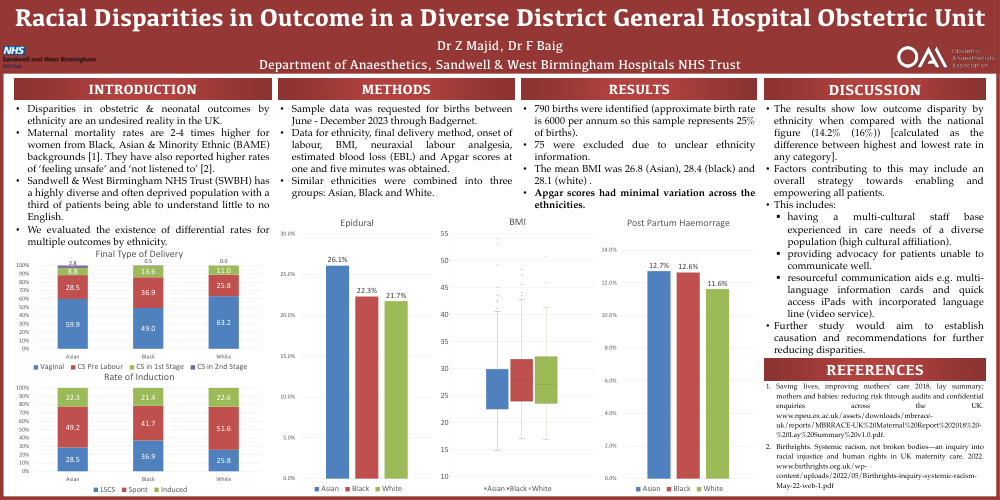
•790 births were identified (approximate birth rate is 6000 per annum so this sample represents 25% of births).
•75 were excluded due to unclear ethnicity information.
•The mean BMI was 26.8 (Asian), 28.4 (black) and 28.1 (white) .
•Apgar scores had minimal variation across the ethnicities.
DISCUSSION
•The results show low outcome disparity by ethnicity when compared with the national figure (14.2% (16%)) [calculated as the difference between highest and lowest rate in any category].
•Factors contributing to this may include an overall strategy towards enabling and empowering all patients.
•This includes:
§having a multi-cultural staff base experienced in care needs of a diverse population (high cultural affiliation).
§providing advocacy for patients unable to communicate well.
§resourceful communication aids e.g. multi-language information cards and quick access iPads with incorporated language line (video service).
•Further study would aim to establish causation and recommendations for further reducing disparities.
REFERENCES
1.Saving lives, improving mothers’ care 2018, lay summary; mothers and babies: reducing risk through audits and confidential enquiries across the UK. www.npeu.ox.ac.uk/assets/downloads/mbrrace-uk/reports/MBRRACE-UK%20Maternal%20Report%202018%20-%20Lay%20Summary%20v1.0.pdf.
2.Birthrights. Systemic racism, not broken bodies—an inquiry into racial injustice and human rights in UK maternity care. 2022. www.birthrights.org.uk/wp-content/uploads/2022/05/Birthrights-inquiry-systemic-racism-May-22-web-1.pdf