150 posters, 16 sessions, 294 authors, 70 institutions
ePostersLive by SciGen Technologies S.A. All rights reserved.
Obstetric Anaesthesia Annual Scientific Meeting 2024
Thursday 9 - Friday 10 May 2024, Birmingham

6288628
Analysis of mode of delivery by anaesthesia and ethnicity at North Bristol NHS Trust central delivery suite.
Poster Presenter
Authors
Affiliations
Part of Topic
Analysis of mode of delivery by anaesthesia and ethnicity at North Bristol NHS Trust central delivery suite
Isra Salah, Sethina Watson, Rachel Wood
University of Bristol Medical School, North Bristol NHS Trust
Introduction
A recent nationwide cohort study [1] found that general anaesthesia (GA) for caesarean sections (CS) was 58% more common in Caribbean (black or black British) women and 35% more common in African (black or black British) women compared to British white women.
This project aimed to identify differences in obstetric anaesthesia care delivery at the North Bristol Trust (NBT) compared to this study. Specifically, we wanted to determine that there were no differences between ethnic groups in percentages receiving general anaesthesia (GA).
Methodology
Results
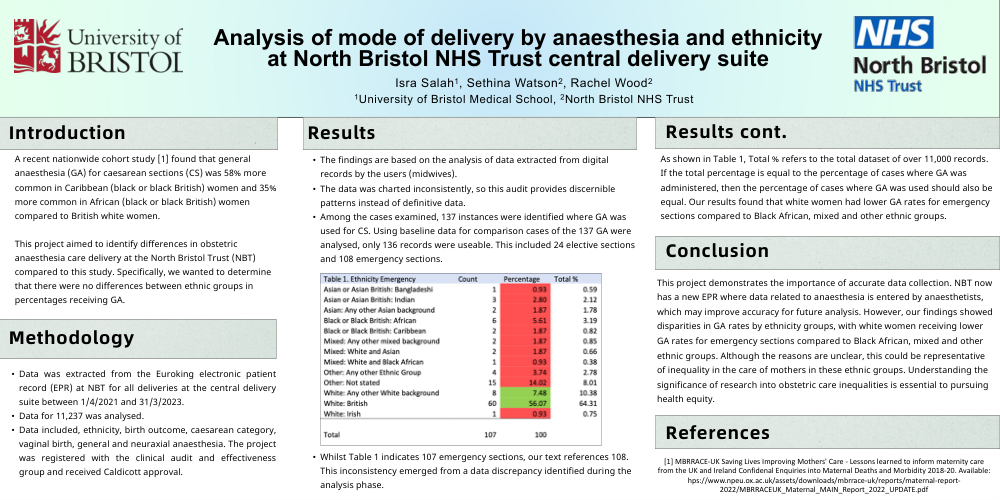
As shown in Table 1, Total % refers to the total dataset of over 11,000 records. If the total percentage is equal to the percentage of cases where GA was administered, then the percentage of cases where GA was used should also be equal. Our results found that white women had lower GA rates for emergency sections compared to Black African, mixed and other ethnic groups.
Conclusion
This project demonstrates the importance of accurate data collection. NBT now has a new EPR where data related to anaesthesia is entered by anaesthetists, which may improve accuracy for future analysis. However, our findings showed disparities in GA rates by ethnicity groups, with white women receiving lower GA rates for emergency sections compared to Black African, mixed and other ethnic groups. Although the reasons are unclear, this could be representative of inequality in the care of mothers in these ethnic groups. Understanding the significance of research into obstetric care inequalities is essential to pursuing health equity.
References
[1] MBRRACE-UK Saving Lives Improving Mothers' Care - Lessons learned to inform maternity care from the UK and Ireland Confidenal Enquiries into Maternal Deaths and Morbidity 2018-20. Available: hps://www.npeu.ox.ac.uk/assets/downloads/mbrrace-uk/reports/maternal-report-2022/MBRRACEUK_Maternal_MAIN_Report_2022_UPDATE.pdf