150 posters, 16 sessions, 294 authors, 70 institutions
ePostersLive by SciGen Technologies S.A. All rights reserved.
Obstetric Anaesthesia Annual Scientific Meeting 2024
Thursday 9 - Friday 10 May 2024, Birmingham

6299799
When typical and atypical presentations collide
Poster Presenter
Part of Topic
When typical and atypical presentations collide
Authors: Dr E. Whittingham ST7 anaesthetist University Hospitals Coventry and Warwickshire (UHCW), Dr C. Grove anaesthetist UHCW, Dr V. Madden, consultant anaesthetist UHCW
Introduction
Post partum headaches are a common presentation, with up to a third of women presenting in the first week after childbirth with the symptom. It has a long list of differentials which can be narrowed by careful clinical history and examination. Most of these presentations are benign primary headaches, such as migraine or tension headache1
We present a case of pituitary apoplexy. This rare condition may present in the postpartum period2 and like all conditions it can present atypically. In our case it presented with features in keeping with a common cause of postpartum headache reminding us to our differential list open even whilst managing a presumed diagnosis.
The case
The patient presented to labour ward triage three days post partum with a postural headache. She was otherwise well. During her labour she had received a lumbar epidural which was uneventful. She had a normal vaginal delivery with a post partum haemorrhage of 1 litre, which was appropriately managed and she had no significant haemodynamic compromise.
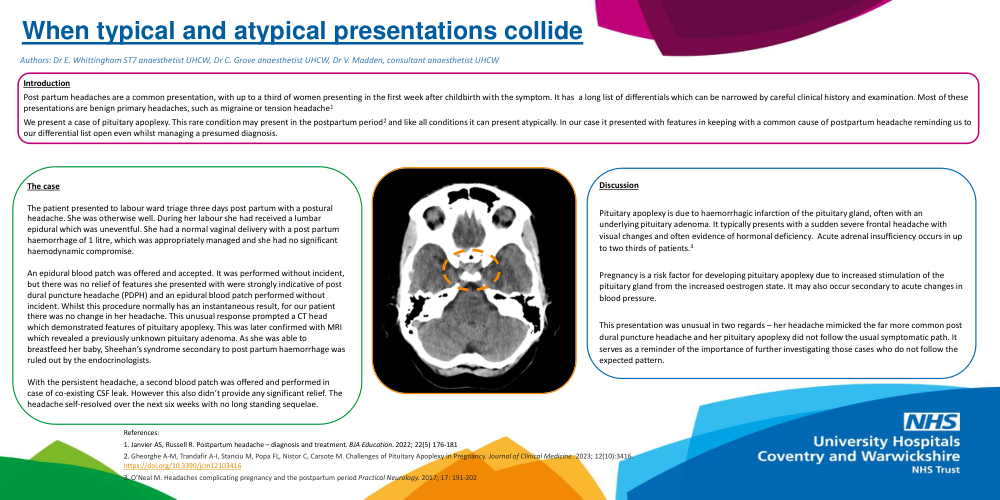
An epidural blood patch was offered and accepted. It was performed without incident, but there was no relief of features she presented with were strongly indicative of post dural puncture headache (PDPH) and an epidural blood patch performed without incident. Whilst this procedure normally has an instantaneous result, for our patient there was no change in her headache. This unusual response prompted a CT head which demonstrated features of pituitary apoplexy. This was later confirmed with MRI which revealed a previously unknown pituitary adenoma. As she was able to breastfeed her baby, Sheehan’s syndrome secondary to post partum haemorrhage was ruled out by the endocrinologists.
With the persistent headache, a second blood patch was offered and performed in case of co-existing CSF leak. However this also didn’t provide any significant relief. The headache self-resolved over the next six weeks with no long standing sequelae.
Discussion
Pituitary apoplexy is due to haemorrhagic infarction of the pituitary gland, often with an underlying pituitary adenoma. It typically presents with a sudden severe frontal headache with visual changes and often evidence of hormonal deficiency. Acute adrenal insufficiency occurs in up to two thirds of patients.3
Pregnancy is a risk factor for developing pituitary apoplexy due to increased stimulation of the pituitary gland from the increased oestrogen state. It may also occur secondary to acute changes in blood pressure.
This presentation was unusual in two regards – her headache mimicked the far more common post dural puncture headache and her pituitary apoplexy did not follow the usual symptomatic path. It serves as a reminder of the importance of further investigating those cases who do not follow the expected pattern.
References:
1. Janvier AS, Russell R. Postpartum headache – diagnosis and treatment. BJA Education. 2022; 22(5) 176-181
2. Gheorghe A-M, Trandafir A-I, Stanciu M, Popa FL, Nistor C, Carsote M. Challenges of Pituitary Apoplexy in Pregnancy. Journal of Clinical Medicine. 2023; 12(10):3416. https://doi.org/10.3390/jcm12103416
3. O’Neal M. Headaches complicating pregnancy and the postpartum period Practical Neurology. 2017; 17: 191-202