150 posters, 16 sessions, 294 authors, 70 institutions
ePostersLive by SciGen Technologies S.A. All rights reserved.
Obstetric Anaesthesia Annual Scientific Meeting 2024
Thursday 9 - Friday 10 May 2024, Birmingham

6301939
Mitigation of Entonox emissions, a quality improvement project
Poster Presenter
Authors
Part of Topic
Mitigation of Entonox Emissions, A Quality Improvement Project
INTRODUCTION
The commonly used anaesthetic agent, Nitrous oxide has a global warming potential 300 times higher than
carbon dioxide (CO ). Intermittent inhalation of Entonox which is a mix of 50% Nitrous oxide and oxygen is a safe
and commonly used form of analgesia for labour, as well as other medical procedures. When exhaled into the
atmosphere after use it persists for 120 years. In 2019/20, Cardiff and Vale emitted 4500 tonnes of CO e from
Entonox use, comparable to driving 930 times around the world in a petrol car. Our aim is to reduce emissions of
Entonox without limiting patient choice or restricting access to pain relief.
METHODS
Three Entonox manifolds were identified on our site. One supplied the Emergency department(ED). The other two
supply maternity and the Children’s Hospital.
PDSA cycle 1: Manifold maintenance
Previous work on N O has shown that manifolds can leak[1]. The first PDSA cycle was to check for leaks, carry out
repairs and upgrade the panel on the maternity manifold.
PDSA cycle 2: Remove unnecessary manifolds
An audit in the ED found that Entonox use has declined with the introduction of penthrox and that there was an
oversupply of wall outlets. A pilot using small Entonox cylinders was successful, resulting in the closure of the ED
manifold in September 2023.
PDSA cycle 3: Unplug handsets when not in use.
Work done in Hull showed wall outlets can cause microleaks and wastage[2]. In September 2023, we changed
the practice to unplug the handsets in the maternity unit when not in use. A weekly audit was done to monitor
compliance.
RESULTS
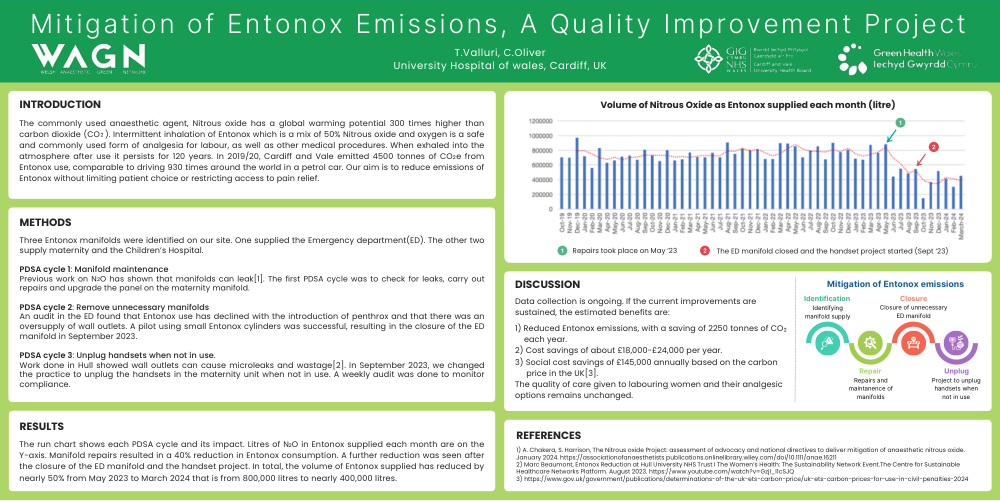
The run chart shows each PDSA cycle and its impact. Litres of N O in Entonox supplied each month are on the
Y-axis. Manifold repairs resulted in a 40% reduction in Entonox consumption. A further reduction was seen after
the closure of the ED manifold and the handset project. In total, the volume of Entonox supplied has reduced by
nearly 50% from May 2023 to March 2024 that is from 800,000 litres to nearly 400,000 litres.
DISCUSSION
Data collection is ongoing. If the current improvements are
sustained, the estimated benefits are:
1) Reduced Entonox emissions, with a saving of 2250 tonnes of CO
each year.
2) Cost savings of about £18,000-£24,000 per year.
3) Social cost savings of £145,000 annually based on the carbon
price in the UK[3].
The quality of care given to labouring women and their analgesic
options remains unchanged.
REFERENCES
1) A. Chakera, S. Harrison, The Nitrous oxide Project: assessment of advocacy and national directives to deliver mitigation of anaesthetic nitrous oxide.
January 2024. https://associationofanaesthetists publications.onlinelibrary.wiley.com/doi/10.1111/anae.16211
2) Marc Beaumont, Entonox Reduction at Hull University NHS Trust I The Women’s Health: The Sustainability Network Event.The Centre for Sustainable
Healthcare Networks Platform. August 2023. https://www.youtube.com/watch?v=Gzjl_l1cSJQ
3) https://www.gov.uk/government/publications/determinations-of-the-uk-ets-carbon-price/uk-ets-carbon-prices-for-use-in-civil-penalties-2024