150 posters, 16 sessions, 294 authors, 70 institutions
ePostersLive by SciGen Technologies S.A. All rights reserved.
Obstetric Anaesthesia Annual Scientific Meeting 2024
Thursday 9 - Friday 10 May 2024, Birmingham

6301886
Carbetocin versus oxytocin at caesarean section: a service evaluation and potential dosing strategy.
Poster Presenter
Authors
Affiliations
Part of Topic
Carbetocin versus oxytocin at caesarean section: a service evaluation and potential dosing strategy.
Introduction
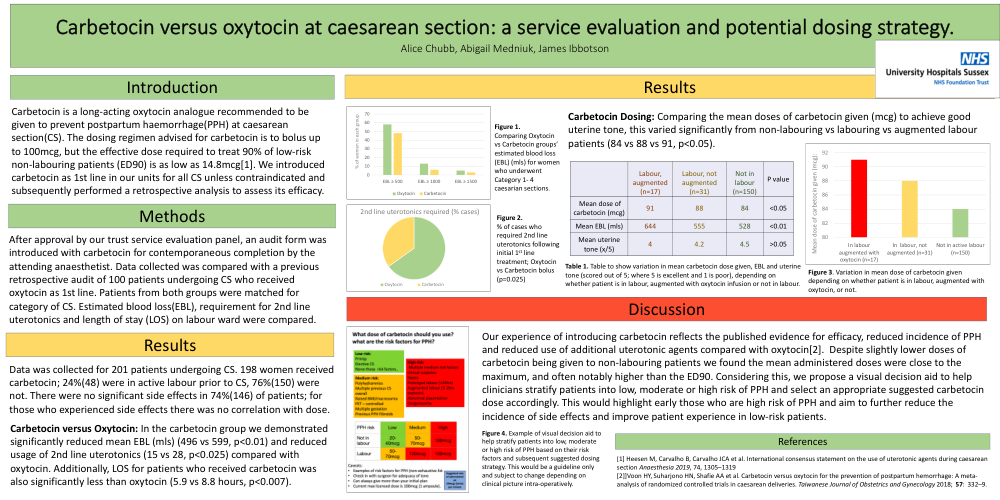
Carbetocin is a long-acting oxytocin analogue recommended to be given to prevent postpartum haemorrhage(PPH) at caesarean section(CS). The dosing regimen advised for carbetocin is to bolus up to 100mcg, but the effective dose required to treat 90% of low-risk non-labouring patients (ED90) is as low as 14.8mcg[1]. We introduced carbetocin as 1st line in our units for all CS unless contraindicated and subsequently performed a retrospective analysis to assess its efficacy.
Methods
After approval by our trust service evaluation panel, an audit form was introduced with carbetocin for contemporaneous completion by the attending anaesthetist. Data collected was compared with a previous retrospective audit of 100 patients undergoing CS who received oxytocin as 1st line. Patients from both groups were matched for category of CS. Estimated blood loss(EBL), requirement for 2nd line uterotonics and length of stay (LOS) on labour ward were compared.
Results
Data was collected for 201 patients undergoing CS. 198 women received carbetocin; 24%(48) were in active labour prior to CS, 76%(150) were not. There were no significant side effects in 74%(146) of patients; for those who experienced side effects there was no correlation with dose. Comparing the mean doses of carbetocin given(mcg) to achieve good uterine tone, this varied significantly from non-labouring vs labouring vs augmented labour patients(84 vs 88 vs 91, p<0.05). In the carbetocin group we demonstrated significantly reduced mean EBL(mls)(496 vs 599, p<0.01) and reduced usage of 2nd line uterotonics(15 vs 28, p<0.025) compared with oxytocin. Finally, LOS for patients who received carbetocin was also significantly less than oxytocin(5.9 vs 8.8 hours, p<0.007) .
Discussion
Our experience of introducing carbetocin reflects the published evidence for efficacy, reduced incidence of PPH and reduced use of additional uterotonic agents compared with oxytocin[2]. Despite slightly lower doses of carbetocin being given to non-labouring patients we found the mean administered doses were close to the maximum, and often notably higher than the ED90. Considering this, we propose a visual decision aid to help clinicians stratify patients into low, moderate or high risk of PPH and select an appropriate suggested carbetocin dose accordingly. This would highlight early those who are high risk of PPH and aim to further reduce the incidence of side effects and improve patient experience in low-risk patients.
References
[1] Heesen M, Carvalho B, Carvalho JCA et al. International consensus statement on the use of uterotonic agents during caesarean section Anaesthesia 2019, 74, 1305–1319
[2] Voon HY, Suharjono HN, Shafie AA et al. Carbetocin versus oxytocin for the prevention of postpartum hemorrhage: A meta-analysis of randomized controlled trials in caesarean deliveries. Taiwanese Journal of Obstetrics and Gynecology 2018; 57: 332–9.