150 posters, 16 sessions, 294 authors, 70 institutions
ePostersLive by SciGen Technologies S.A. All rights reserved.
Obstetric Anaesthesia Annual Scientific Meeting 2024
Thursday 9 - Friday 10 May 2024, Birmingham

6301349
Cerebellar ataxia in pregnancy - is spinal anaesthesia safe?
Poster Presenter
Authors
Affiliations
Part of Topic
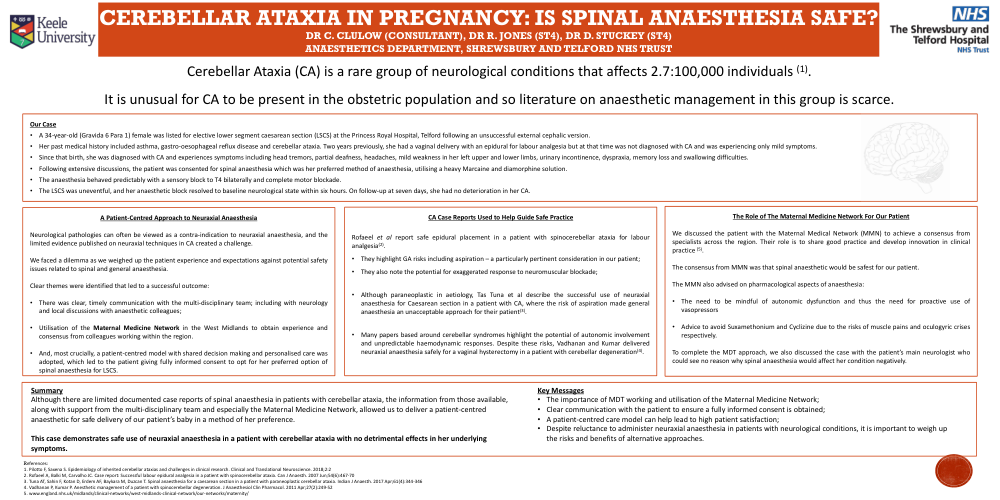
CEREBELLAR ATAXIA IN PREGNANCY: IS SPINAL ANAESTHESIA SAFE?
DR C. CLULOW (CONSULTANT), DR R. JONES (ST4), DR D. STUCKEY (ST4) ANAESTHETICS DEPARTMENT, SHREWSBURY AND TELFORD NHS TRUST Cerebellar Ataxia (CA) is a rare group of neurological conditions that affects 2.7:100,000 individuals (1) . It is unusual for CA to be present in the obstetric population and so literature on anaesthetic management in this group is scarce.
Our Case • A 34-year-old (Gravida 6 Para 1) female was listed for elective lower segment caesarean section (LSCS) at the Princess Royal Hospital, Telford following an unsuccessful external cephalic version. • Her past medical history included asthma, gastro-oesophageal reflux disease and cerebellar ataxia. Two years previously, she had a vaginal delivery with an epidural for labour analgesia but at that time was not diagnosed with CA and was experiencing only mild symptoms. • Since that birth, she was diagnosed with CA and experiences symptoms including head tremors, partial deafness, headaches, mild weakness in her left upper and lower limbs, urinary incontinence, dyspraxia, memory loss and swallowing difficulties. • Following extensive discussions, the patient was consented for spinal anaesthesia which was her preferred method of anaesthesia, utilising a heavy Marcaine and diamorphine solution. • The anaesthesia behaved predictably with a sensory block to T4 bilaterally and complete motor blockade. • The LSCS was uneventful, and her anaesthetic block resolved to baseline neurological state within six hours. On follow-up at seven days, she had no deterioration in her CA.
A Patient-Centred Approach to Neuraxial Anaesthesia Neurological pathologies can often be viewed as a contra-indication to neuraxial anaesthesia, and the limited evidence published on neuraxial techniques in CA created a challenge. We faced a dilemma as we weighed up the patient experience and expectations against potential safety issues related to spinal and general anaesthesia. Clear themes were identified that led to a successful outcome: • There was clear, timely communication with the multi-disciplinary team; including with neurology and local discussions with anaesthetic colleagues; • Utilisation of the Maternal Medicine Network in the West Midlands to obtain experience and consensus from colleagues working within the region. • And, most crucially, a patient-centred model with shared decision making and personalised care was adopted, which led to the patient giving fully informed consent to opt for her preferred option of spinal anaesthesia for LSCS.
CA Case Reports Used to Help Guide Safe Practice Rofaeel et al report safe epidural placement in a patient with spinocerebellar ataxia for labour analgesia (2) . • They highlight GA risks including aspiration – a particularly pertinent consideration in our patient; • They also note the potential for exaggerated response to neuromuscular blockade; • Although paraneoplastic in aetiology, Tas Tuna et al describe the successful use of neuraxial anaesthesia for Caesarean section in a patient with CA, where the risk of aspiration made general anaesthesia an unacceptable approach for their patient (3) . • Many papers based around cerebellar syndromes highlight the potential of autonomic involvement and unpredictable haemodynamic responses. Despite these risks, Vadhanan and Kumar delivered neuraxial anaesthesia safely for a vaginal hysterectomy in a patient with cerebellar degeneration (4) .
The Role of The Maternal Medicine Network For Our Patient We discussed the patient with the Maternal Medical Network (MMN) to achieve a consensus from specialists across the region. Their role is to share good practice and develop innovation in clinical practice (5) . The consensus from MMN was that spinal anaesthetic would be safest for our patient. The MMN also advised on pharmacological aspects of anaesthesia: • The need to be mindful of autonomic dysfunction and thus the need for proactive use of vasopressors • Advice to avoid Suxamethonium and Cyclizine due to the risks of muscle pains and oculogyric crises respectively. To complete the MDT approach, we also discussed the case with the patient’s main neurologist who could see no reason why spinal anaesthesia would affect her condition negatively.
Summary Although there are limited documented case reports of spinal anaesthesia in patients with cerebellar ataxia, the information from those available, along with support from the multi-disciplinary team and especially the Maternal Medicine Network, allowed us to deliver a patient-centred anaesthetic for safe delivery of our patient’s baby in a method of her preference. This case demonstrates safe use of neuraxial anaesthesia in a patient with cerebellar ataxia with no detrimental effects in her underlying symptoms.
Key Messages • The importance of MDT working and utilisation of the Maternal Medicine Network; • Clear communication with the patient to ensure a fully informed consent is obtained; • A patient-centred care model can help lead to high patient satisfaction; • Despite reluctance to administer neuraxial anaesthesia in patients with neurological conditions, it is important to weigh up the risks and benefits of alternative approaches.
References: 1. Pilotto F, Saxena S. Epidemiology of inherited cerebellar ataxias and challenges in clinical research. Clinical and Translational Neuroscience. 2018;2:2 2. Rofaeel A, Balki M, Carvalho JC. Case report: Successful labour epidural analgesia in a patient with spinocerebellar ataxia. Can J Anaesth. 2007 Jun;54(6):467-70 3. Tuna AT, Sahin F, Kotan D, Erdem AF, Baykara M, Duzcan T. Spinal anaesthesia for a caesarean section in a patient with paraneoplastic cerebellar ataxia. Indian J Anaesth. 2017 Apr;61(4):344-346 4. Vadhanan P, Kumar P. Anesthetic management of a patient with spinocerebellar degeneration. J Anaesthesiol Clin Pharmacol. 2011 Apr;27(2):249-52 5. www.england.nhs.uk/midlands/clinical-networks/west-midlands-clinical-network/our-networks/maternity/