150 posters, 16 sessions, 294 authors, 70 institutions
ePostersLive by SciGen Technologies S.A. All rights reserved.
Obstetric Anaesthesia Annual Scientific Meeting 2024
Thursday 9 - Friday 10 May 2024, Birmingham

6281067
Autoimmune encephalitis: case report of a rare condition in pregnancy.
Poster Presenter
Authors
Affiliations
Part of Topic
Autoimmune encephalitis: a case report of a rare condition in pregnancy
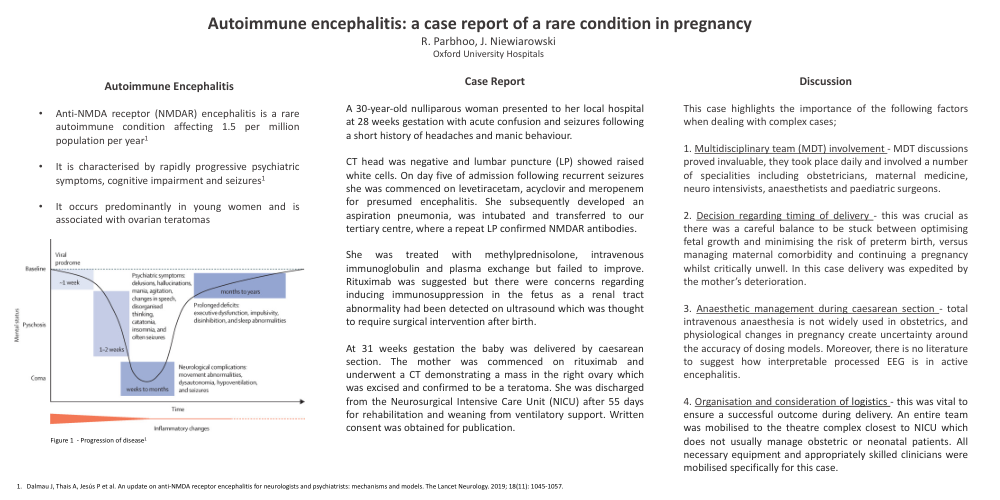
Autoimmune Encephalitis
Case Report
A 30-year-old nulliparous woman presented to her local hospital at 28 weeks gestation with acute confusion and seizures following a short history of headaches and manic behaviour.
CT head was negative and lumbar puncture (LP) showed raised white cells. On day five of admission following recurrent seizures she was commenced on levetiracetam, acyclovir and meropenem for presumed encephalitis. She subsequently developed an aspiration pneumonia, was intubated and transferred to our tertiary centre, where a repeat LP confirmed NMDAR antibodies.
She was treated with methylprednisolone, intravenous immunoglobulin and plasma exchange but failed to improve. Rituximab was suggested but there were concerns regarding inducing immunosuppression in the fetus as a renal tract abnormality had been detected on ultrasound which was thought to require surgical intervention after birth.
At 31 weeks gestation the baby was delivered by caesarean section. The mother was commenced on rituximab and underwent a CT demonstrating a mass in the right ovary which was excised and confirmed to be a teratoma. She was discharged from the Neurosurgical Intensive Care Unit (NICU) after 55 days for rehabilitation and weaning from ventilatory support. Written consent was obtained for publication.
Discussion
This case highlights the importance of the following factors when dealing with complex cases;
1. Multidisciplinary team (MDT) involvement - MDT discussions proved invaluable, they took place daily and involved a number of specialities including obstetricians, maternal medicine, neuro intensivists, anaesthetists and paediatric surgeons.
2. Decision regarding timing of delivery - this was crucial as there was a careful balance to be stuck between optimising fetal growth and minimising the risk of preterm birth, versus managing maternal comorbidity and continuing a pregnancy whilst critically unwell. In this case delivery was expedited by the mother’s deterioration.
3. Anaesthetic management during caesarean section - total intravenous anaesthesia is not widely used in obstetrics, and physiological changes in pregnancy create uncertainty around the accuracy of dosing models. Moreover, there is no literature to suggest how interpretable processed EEG is in active encephalitis.
4. Organisation and consideration of logistics - this was vital to ensure a successful outcome during delivery. An entire team was mobilised to the theatre complex closest to NICU which does not usually manage obstetric or neonatal patients. All necessary equipment and appropriately skilled clinicians were mobilised specifically for this case.