150 posters, 16 sessions, 294 authors, 70 institutions
ePostersLive by SciGen Technologies S.A. All rights reserved.
Obstetric Anaesthesia Annual Scientific Meeting 2024
Thursday 9 - Friday 10 May 2024, Birmingham

6301717
Evaluation of current practice of local anaesthetic dose in relation with height and weight for caesarean sections.
Poster Presenter
Authors
Affiliations
null,
Part of Topic
Evaluation of current practice of local anaesthetic dose in relation with height and weight for caesarean sections.
Introduction: It is well known that the severity of hypotension is directly related
with a dose of hyperbaric bupivacaine used in spinal for caesarean sections.
Studies have shown that adjusting the dose of intrathecal bupivacaine according
to the patient's height and weight could provide adequate surgical anaesthesia
section while decreasing the incidence of maternal hypotension and the use of
vasopressors.[1,2] With the aim to reduce complications in our patients due to
high local anaesthetic doses, we wanted to evaluate our current practice
whether doses of local anaesthetic are being adjusted as per height and weight
or not.
Methods: After taking trust audit department approval , we collected data for a
period of one month for height, weight , dose of heavy bupivacaine used in
spinals and incidence of hypotension for both elective and emergency
caesearean sections. Data from 118 patients was collected .
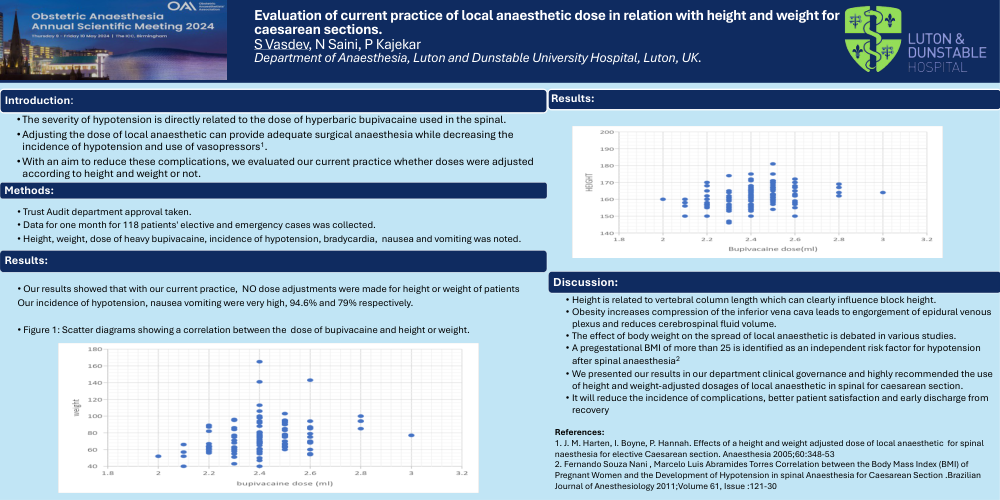
Results : Our results showed that with our current practice no dose
adjustments were made for height and weight of the patients . The scatter
diagrams shown in figure one showed no corelation between dose of
bupivaicaine and height or weight of the patient. We noticed that our incidence
of hypotension and nausea vomiting were very high,94.6% and 79% respectively.
Discussion: The height is related with vertebral column length and the vertebral
column length can influence the block level. The influence of body weight on
subarachnoid spread of local anaesthetic is debated in various studies.
However,pregestational body mass index ≥ 25 kg.m −2 has been identified as an
independent risk factor for hypotension after spinal anesthesia in patients
undergoing cesarean section [3]Studies have shown that the extent of the block
after spinal dose depends on the height and weight of the patient, hence
adjusting dose of bupivacaine for these variables will provide adequate
anaesthesia without excessive maternal hypotension.[1,2] .Lower dose can be
used for obese patient by combined spinal epidural technique without risk of
inadequate anaesthesia.We presented our results in departmental clinical
governance meeting and highly recommended to follow height and weight
adjusted dose regime for spinals in caesearean sections.