150 posters, 16 sessions, 294 authors, 70 institutions
ePostersLive by SciGen Technologies S.A. All rights reserved.
Obstetric Anaesthesia Annual Scientific Meeting 2024
Thursday 9 - Friday 10 May 2024, Birmingham

6300961
A retrospective study of the implementation of a lidocaine epidural top up policy
Poster Presenter
Authors
Part of Topic
Introduction:
In 2022, there were 1633 emergency caesarean sections(CS) performed in the Rotunda Hospital. To address variation in clinical practice, a policy on converting epidural analgesia to anaesthesia for CS was implemented. This recommended a lidocaine, adrenaline and fentanyl (LAF) mixture.
Methods:
ØWe evaluated the electronic patient records of 200 intrapartum CS who delivered between February and July 2023 (Group L; post LAF policy) and compared them to 200 patients who delivered from July to October 2021 (Group C: pre LAF policy).
ØWe compared the local anaesthetic agents used, the volume administered, use of epidural fentanyl, need for supplemental analgesia, conversion to general anaesthesia (GA)and the prevalence of associated complications.
Results:
ØLidocaine was used as a single agent in 199/200 (99%) of cases in Group L vs 70/200 (35%) in Group C, p<0.01. In group C, lidocaine + bupivacaine was the most frequent combination (61.5%), followed by lidocaine + levobupivacaine (4%).
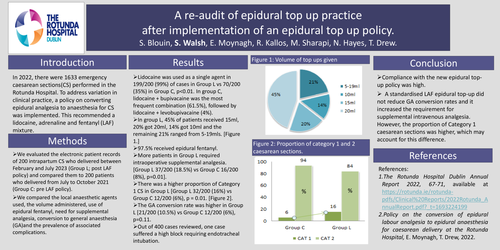
ØIn group L, 45% of patients received 15ml, 20% got 20ml, 14% got 10ml and the remaining 21% ranged from 5-19mls. [Figure 1.]
Ø97.5% received epidural fentanyl.
ØMore patients in Group L required intraoperative supplemental analgesia. [Group L 37/200 (18.5%) vs Group C 16/200 (8%), p=0.01].
ØThere was a higher proportion of Category 1 CS in Group L [Group L 32/200 (16%) vs Group C 12/200 (6%), p = 0.01. [Figure 2].
ØThe GA conversion rate was higher in Group L [21/200 (10.5%) vs Group C 12/200 (6%), p=0.11.
ØOut of 400 cases reviewed, one case suffered a high block requiring endotracheal intubation.
Conclusion:
ØCompliance with the new epidural top-up policy was high.
Ø A standardised LAF epidural top-up did not reduce GA conversion rates and it increased the requirement for supplemental intravenous analgesia. However, the proportion of Category 1 caesarean sections was higher, which may account for this difference.