150 posters, 16 sessions, 294 authors, 70 institutions
ePostersLive by SciGen Technologies S.A. All rights reserved.
Obstetric Anaesthesia Annual Scientific Meeting 2024
Thursday 9 - Friday 10 May 2024, Birmingham

6299676
Prevalence and Risk Factors for Chronic Postsurgical Pain After Cesarean Section -- A Prospective Study in A Tertiary Care Hospital of Bangladesh.
Poster Presenter
Authors
Affiliations
Part of Topic
Abstract ID – 6299676
Title:
Prevalence and Risk Factors for Chronic Postsurgical Pain After Cesarean Section – A Prospective Study in A Tertiary Care Hospital of Bangladesh.
Introduction :
The number of cesarean section (CS) has significantly risen both in developed and developing countries in recent decades[1].Chronic post-postsurgical pain (CPSP) is a significant clinical issue that persists after CS, potentially leading to limitations in daily activities and a decline in overall quality of life. The documented prevalence of chronic post-surgical pain (CPSP) after cesarean section (CS) has varied from 1% to 23% within one year of the procedure[2]. Little is known about CPSP after CS in Bangladesh. Hence, this prospective study sought to ascertain the occurrence and examine the factors that contribute to the development of chronic post-surgical pain (CPSP) in our population at 3, 6, and 12 months following cesarean section (CS).
Methods :
This prospective cohort study was conducted at Chittagong Medical College Hospital in Bangladesh, after ethical clearance from the ethical review board of Chittagong Medical College. The study took place from July 2022 to December 2023. After obtaining informed written consent, a total of 607 women with ASA grade I & II who underwent elective cesarean section were included in the study. We collected data on preoperative demographic and psychological variables and investigated the occurrence of acute post-operative pain. Each of the women who took part in the study were individually interviewed regarding CPSP and provided responses to questionnaires at 3, 6, and 12 months. The inquiries pertained to the severity, frequency, location, received treatment, and influence on everyday activities of the pain.
Results :
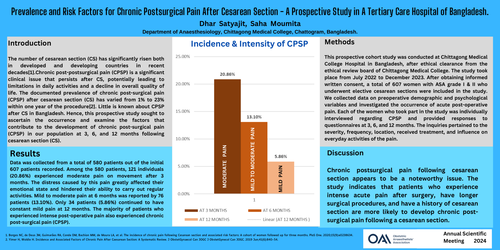
Data was collected from a total of 580 patients out of the initial 607 patients recorded. Among the 580 patients, 121 individuals (20.86%) experienced moderate pain on movement after 3 months. The distress caused by this pain greatly affected their emotional state and hindered their ability to carry out regular activities. Mild to moderate pain at 6 months was reported by 76 patients (13.10%). Only 34 patients (5.86%) continued to have constant mild pain at 12 months. The majority of patients who experienced intense post-operative pain also experienced chronic post-surgical pain (CPSP).
Discussion :
Chronic postsurgical pain following cesarean section appears to be a noteworthy issue. The study indicates that patients who experience intense acute pain after surgery, have longer surgical procedures, and have a history of cesarean section are more likely to develop chronic post-surgical pain following a cesarean section.
References:
1. Borges NC, de Deus JM, Guimarães RA, Conde DM, Bachion MM, de Moura LA, et al. The incidence of chronic pain following Cesarean section and associated risk factors: A cohort of women followed up for three months. PloS One. 2020;15(9):e0238634.
2. Yimer H, Woldie H. Incidence and Associated Factors of Chronic Pain After Caesarean Section: A Systematic Review. J ObstetGynaecol Can JOGC J ObstetGynecol Can JOGC. 2019 Jun;41(6):840–54.
Authors :
Dhar Satyajit, Saha Moumita
Chittagong Medical College, Chattogram, Bangladesh.