150 posters, 16 sessions, 294 authors, 70 institutions
ePostersLive by SciGen Technologies S.A. All rights reserved.
Obstetric Anaesthesia Annual Scientific Meeting 2024
Thursday 9 - Friday 10 May 2024, Birmingham

6299074
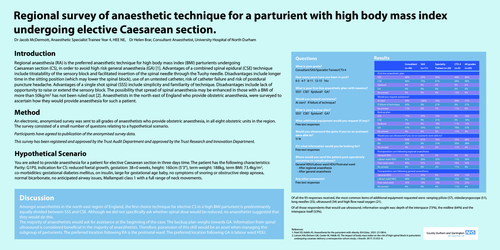
Regional survey of anaesthetic technique for a parturient with high body mass index undergoing elective Caesarean section.
Poster Presenter
Part of Topic
Regional survey of anaesthetic technique for a parturient with high body mass index
undergoing elective Caesarean section.
Dr Jacob McDermott, Anaesthetic Specialist Trainee Year 4, HEE NE, Dr Helen Brar, Consultant Anaesthetist, University Hospital of North Durham
Introduction
Regional anaesthesia (RA) is the preferred anaesthetic technique for high body mass index (BMI) parturients undergoing Caesarean section (CS), in order to avoid high risk general anaesthesia (GA) [1]. Advantages of a combined spinal epidural (CSE) technique include titratability of the sensory block and facilitated insertion of the spinal needle through the Tuohy needle. Disadvantages include longer time in the sitting position (which may lower the spinal block), use of an untested catheter, risk of catheter failure and risk of postdural puncture headache. Advantages of a single shot spinal (SSS) include simplicity and familiarity of technique. Disadvantages include lack of opportunity to raise or extend the sensory block. The possibility that spread of spinal anaesthesia may be enhanced in those with a BMI of more than 50kg/m2 has not been ruled out [2]. Anaesthetists in the north east of England who provide obstetric anaesthesia, were surveyed to ascertain how they would provide anaesthesia for such a patient.
Method
An electronic, anonymised survey was sent to all grades of anaesthetists who provide obstetric anaesthesia, in all eight obstetric units in the region.
The survey consisted of a small number of questons relating to a hypothetical scenario.
Participants have agreed to publication of the anonymised survey data.
This survey has been registered and approved by the Trust Audit Department and approved by the Trust Research and Innovation Department.
Hypothetical Scenario
You are asked to provide anaesthesia for a patient for elective Caesarean section in three days time. The patient has the following characteristics:
Parity: G1P0, indication for CS: reduced foetal growth, gestation: 38+0 weeks, height: 160cm (5’3’’), term weight: 188kg, term BMI: 73.4kg/m2, co-morbidities: gestational diabetes mellitus, on insulin, large for gestational age baby, no symptoms of snoring or obstructive sleep apnoea, normal bicarbonate, no anticipated airway issues, Mallampati class 1 with a full range of neck movements.
Discussion
Amongst anaesthetists in the north east region of England, the rst choice technique for elective CS in a high BMI parturient is predominantly
equally divided between SSS and CSE. Although we did not specically ask whether spinal dose would be reduced, no anaesthetist suggested that
they would do this.
The majority of anaesthetists would ask for assistance at the beginning of the case. The backup plan weighs towards GA. Information from spinal
ultrasound is considered benecial in the majority of anaesthetists. Therefore, possession of this skill would be an asset when managing this
subgroup of parturients. The preferred location following RA is the postnatal ward. The preferred location following GA is labour ward HDU.
References
1. Patel SD, Habib AS. Anaesthesia for the parturient with obesity. BJA Educ. 2021; 21:180-6.
2. Lamon AM, Einhorn LM, Cooter M, Habib AS. The impact of body mass index on the risk of high spinal block in parturients
undergoing cesarean delivery: a retrospective cohort study. J Anesth. 2017; 31:552–8.