150 posters, 16 sessions, 294 authors, 70 institutions
ePostersLive by SciGen Technologies S.A. All rights reserved.
Obstetric Anaesthesia Annual Scientific Meeting 2024
Thursday 9 - Friday 10 May 2024, Birmingham

6299677
Introduction of short acting spinal anaesthesia for short obstetric procedures
Poster Presenter
Authors
Affiliations
null,
Part of Topic
Introduction of short acting spinal anaesthesia for short obstetric procedures
Dr William Smith, Dr Alexander Grant, Dr Julia Bowditch
Introduction
A quality improvement project conducted in Salisbury District Hospital labour ward aimed at introducing short acting spinal anaesthesia for specific short obstetric procedures (including cervical sutures, manual removal of retained placenta and repair of third-degree tears). The objectives of this project were to promote earlier mobilisation in these patients, reduce the need for urinary catheterisation and ultimate encourage earlier discharge from hospital. By adopting the use of short acting spinal anaesthesia, we sought to improve patient’s postoperative experience and optimise resource utilization.
Methods
An initial audit of practice was conducted looking at the aforementioned obstetric procedures. Data was collected on, type of spinal anaesthesia, operation duration (minutes), vasopressor use, opiate use, urinary catheter insertion, percentage of patients discharged in under twelve hours. In total, twenty-five patients were identified and included.
Following this the anaesthetic and obstetric department were consulted, prilocaine was made available in the obstetric theatres and a protocol was created and agreed upon by both departments. Importantly this included a discussion between the obstetrician and anaesthetist at the team brief as to whether they felt prilocaine was appropriate for the patient and procedure. If prilocaine was felt to be appropriate the obstetrician will need to be in theatre whilst the anaesthetic is being performed.
A prospective audit was then carried out on all patients receiving a prilocaine spinal for the above procedures. The same data was collected as for the initial audit. Ten patients were included in the prilocaine group.
Results
Comparing the prilocaine group to the bupivacaine group, we found that eighty percent of patients in the former did not require opiates, compared to forty-four percent in the latter. Similarly, vasopressor usage was significantly lower in the prilocaine group, with ten percent compared to thirty-two percent in the bupivacaine group.
The average operation duration in minutes in the bupivacaine group was forty-two minutes and thirty-one and a half minutes in the prilocaine group. Catheter use in the prilocaine group was forty percent, in the bupivacaine group this data was not recorded but current practice in the department is all patients who have received a bupivacaine spinal is to receive a catheter post-operatively. Average time to pass urine in the prilocaine group was seven hours, average time to mobilisation was four hours and six minutes, again the initial audit did not capture time to mobilisation for the bupivacaine spinals but practice at the time was that patients were to remain in bed until six hours post spinal.
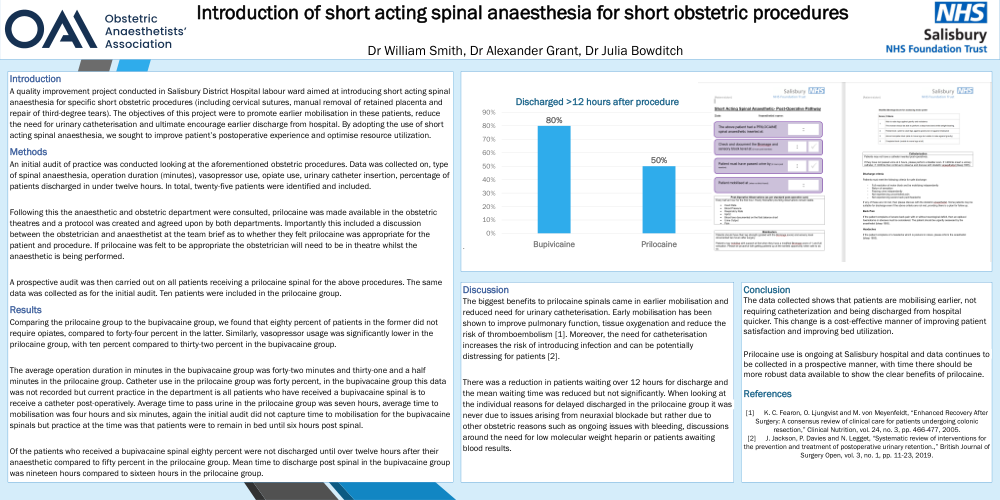
Of the patients who received a bupivacaine spinal eighty percent were not discharged until over twelve hours after their anaesthetic compared to fifty percent in the prilocaine group. Mean time to discharge post spinal in the bupivacaine group was nineteen hours compared to sixteen hours in the prilocaine group.
Discussion
The biggest benefits to prilocaine spinals came in earlier mobilisation and reduced need for urinary catheterisation. Early mobilisation has been shown to improve pulmonary function, tissue oxygenation and reduce the risk of thromboembolism [1]. Moreover, the need for catheterisation increases the risk of introducing infection and can be potentially distressing for patients [2].
There was a reduction in patients waiting over 12 hours for discharge and the mean waiting time was reduced but not significantly. When looking at the individual reasons for delayed discharged in the prilocaine group it was never due to issues arising from neuraxial blockade but rather due to other obstetric reasons such as ongoing issues with bleeding, discussions around the need for low molecular weight heparin or patients awaiting blood results.
Conclusion
The data collected shows that patients are mobilising earlier, not requiring catheterization and being discharged from hospital quicker. This change is a cost-effective manner of improving patient satisfaction and improving bed utilization.
Prilocaine use is ongoing at Salisbury hospital and data continues to be collected in a prospective manner, with time there should be more robust data available to show the clear benefits of prilocaine.
References
[1] K. C. Fearon, O. Ljungvist and M. von Meyenfeldt, “Enhanced Recovery After Surgery: A consensus review of clinical care for patients undergoing colonic resection,” Clinical Nutrition, vol. 24, no. 3, pp. 466-477, 2005.
[2] J. Jackson, P. Davies and N. Legget, “Systematic review of interventions for the prevention and treatment of postoperative urinary retention.,” British Journal of Surgery Open, vol. 3, no. 1, pp. 11-23, 2019.