150 posters, 16 sessions, 294 authors, 70 institutions
ePostersLive by SciGen Technologies S.A. All rights reserved.
Obstetric Anaesthesia Annual Scientific Meeting 2024
Thursday 9 - Friday 10 May 2024, Birmingham

6287202
Variable dosing of remifentanil analgesia during labour
Poster Presenter
Authors
Affiliations
null,
Part of Topic
Variable dosing Remifentanil Patient Controlled Analgesia (PCA) during labour.
Remifentanil is a useful and increasingly popular labour analgesic. Recent NICE guidance suggests considering remifentanil (40mcg/bolus) for ongoing pain relief during labour.[1] A review of our local protocols was prompted by the publication of RemiPCA SAFE Network data[2] with the introduction of a variable dosing protocol (20–40mcg bolus).
Aim
To evaluate the efficacy, safety and uptake of our remifentanil PCA service, focussing on the 12-months since protocol changes were made in July 2022.
Methods
Patients receiving remifentanil PCA in labour were identified using controlled drug books (July 2020–2023). Anaesthetic charts and modes of delivery were reviewed for the most recent 12-months following the change in protocol.
Results
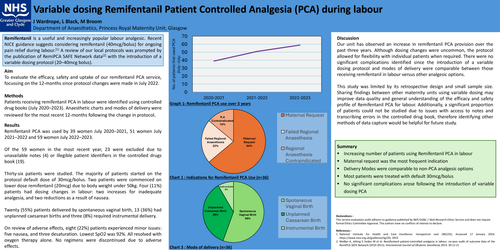
Remifentanil PCA was used by 39 women July 2020–2021, 51 women July 2021–2022 and 59 women July 2022–2023.
Of the 59 women in the most recent year, 23 were excluded due to unavailable notes (4) or illegible patient identifiers in the controlled drugs book (19).
Thirty-six patients were studied. The majority of patients started on the protocol default dose of 30mcg/bolus. Two patients were commenced on lower dose remifentanil (20mcg) due to body weight under 50kg. Four (11%) patients had dosing changes in labour: two increases for inadequate analgesia, and two reductions as a result of nausea.
Twenty (55%) patients delivered by spontaneous vaginal birth, 13 (36%) had unplanned caesarean births and three (8%) required instrumental delivery.
On review of adverse effects, eight (22%) patients experienced minor issues: five nausea, and three desaturation. Lowest SpO2 was 92%. All resolved with oxygen therapy alone. No regimens were discontinued due to adverse effects.
Discussion
Our unit has observed an increase in remifentanil PCA provision over the past three years. Although dosing changes were uncommon, the protocol allowed for flexibility with individual patients when required. There were no significant complications identified since the introduction of a variable dosing protocol and modes of delivery were comparable between those receiving remifentanil in labour versus other analgesic options.
This study was limited by its retrospective design and small sample size. Sharing findings between other maternity units using variable dosing may improve data quality and general understanding of the efficacy and safety profile of Remifentanil PCA for labour. Additionally, a significant proportion of patients could not be studied due to issues with access to notes and transcribing errors in the controlled drug book, therefore identifying other methods of data capture would be helpful for future study.
Summary
Declarations :
This service evaluation audit adheres to guidance published by NHS GG&C / WoS Research Ethics Service and does not require formal Ethics Committee Approval. The authors have no conflicts of interest to declare.
References :