150 posters, 16 sessions, 294 authors, 70 institutions
ePostersLive by SciGen Technologies S.A. All rights reserved.
Obstetric Anaesthesia Annual Scientific Meeting 2024
Thursday 9 - Friday 10 May 2024, Birmingham

6290372
Evaluating Labor Analgesia Modalities: A Comprehensive Audit Comparing Programmed-intermittent Epidural Boluses (PIEB) and Patient-Controlled Epidural
Poster Presenter
Authors
Part of Topic
Evaluating Labor Analgesia Modalities: A Comprehensive Audit Comparing Programmed-intermittent Epidural Boluses (PIEB) and Patient-Controlled Epidural Analgesia (PCEA)
Introduction
•Childbirth is a challenging process often accompanied by intense pain.
•Advanced epidural modalities like Programmed-intermittent Epidural Boluses (PIEB) and traditional Patient-Controlled Epidural Analgesia (PCEA) offer innovative solutions for pain management during labor.
•This audit aimed to compare the effectiveness, safety, and patient satisfaction associated with PIEB and PCEA in a maternity hospital setting, incorporating feedback from patients, nurses, and anesthesia providers.
Methods
•Epidural analgesia, particularly Patient-Controlled Epidural Analgesia (PCEA) and Programmed Intermittent Epidural Bolus (PIEB), is the main method in our institution.
•All parturients received an initial epidural bolus with Bupivacaine and Fentanyl followed by Bupivacaine infusion.
•Pain scores were recorded at various intervals, and overall satisfaction was assessed.
•Data analysis was done using IBM SPSS.
•A survey was conducted among healthcare professionals at the delivery floor and summed up into a form of Qualitative and Quantitative Analysis.
Results
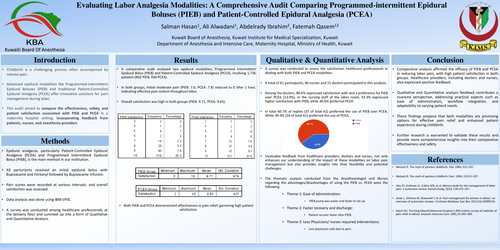
•A comparative audit analyzed two epidural modalities, Programmed Intermittent Epidural Bolus (PIEB) and Patient-Controlled Epidural Analgesia (PCEA), involving 1,736 patients (802 PIEB, 934 PCEA).
•In both groups, initial moderate pain (PIEB: 7.6, PCEA: 7.8) reduced to 0 after 1 hour, indicating effective pain control throughout labor.
•Overall satisfaction was high in both groups (PIEB: 9.71, PCEA: 9.65).
•Both PIEB and PCEA demonstrated effectiveness in pain relief, garnering high patient satisfaction.
Qualitative & Quantitative Analysis
•A survey was conducted to assess the satisfaction healthcare professionals in dealing with both PIEB and PCEA modalities.
•A total of 61 participants, 46 nurses and 15 doctors participated in this analysis.
•Among the doctors, 86.6% expressed satisfaction with and a preference for PIEB over PCEA (13.4%). In the nursing staff of the labor room, 53.3% expressed higher satisfaction with PIEB, while 46.6% preferred PCEA.
•In total 60.7% of replies (37 of total 61) preferred the use of PIEB over PCEA, While 39.3% (24 of total 61) preferred the use of PCEA.
•Invaluable feedback from healthcare providers, doctors and nurses, not only enhances our understanding of the impact of these modalities on labor pain management but also provides insights into their feasibility and potential challenges.
•The thematic analysis conducted from the Anesthesiologist and Nurses regarding the advantages/disadvantages of using the PIEB vs. PCEA were the following:
•Theme 1: Ease of administration:
• PIEB pump was easier and faster to set up.
•Theme 2: Faster recovery and discharge:
•Patient recover faster after PIEB.
•Theme 3: Less Physicians/ nurses required interventions:
Less physicians calls due to pain.
Conculsion
•Comparative analysis affirmed the efficacy of PIEB and PCEA in reducing labor pain, with high patient satisfaction in both groups. Healthcare providers, including doctors and nurses, also expressed positive feedback.
•Qualitative and Quantitative analysis feedback contributes a nuanced perspective, addressing practical aspects such as ease of administration, workflow integration, and adaptability to varying patient needs.
•These findings propose that both modalities are promising options for effective pain relief and enhanced patient experience during childbirth.
•Further research is warranted to validate these results and provide more comprehensive insights into their comparative effectiveness and safety.
References
•Melzack R. The myth of painless childbirth. Pain 1984; 321–337.
•Melzack R. The myth of painless childbirth. Pain. 1984; 19:321–337.
•Likis FE, Andrews JC, Collins MR, et al. Nitrous oxide for the management of labor pain: a systematic review. Anesth Analg. 2014; 118:153–167.
•Jones L, Othman M, Dowswell T, et al. Pain management for women in labour: an overview of systematic reviews. Cochrane Database Syst Rev. 2012;(3):CD009234.
•Paech MJ. The King Edward Memorial Hospital 1,000 mother survey of methods of pain relief in labour. Anaesth Intensive Care. 1991;19:393–399.