150 posters, 16 sessions, 294 authors, 70 institutions
ePostersLive by SciGen Technologies S.A. All rights reserved.
Obstetric Anaesthesia Annual Scientific Meeting 2024
Thursday 9 - Friday 10 May 2024, Birmingham

6274764
Remifentanil Patient Controlled Analgesia (PCA) in labour : A District Generals experience
Poster Presenter
Authors
Affiliations
null,
Part of Topic
Remifentanil patient controlled analgesia (PCA) in labour: A district general’s experience.
G. Sutcliffe, C. Murphy, S. Reed
Anaesthetics, Blackpool Teaching Hospitals NHS Foundation Trust, Blackpool, UK.
INTRODUCTION
Remifentanil patient controlled analgesia (PCA) is an alternative option for labour analgesia in the UK and high maternal satisfaction has been shown with its use.
- NICE 2023 intrapartum care guidelines state that remifentanil PCA may be considered as an option for women who require analgesia during labour and birth1.
- 2020 RCOA guidance states it is crucial for midwives caring for these women to be trained in the use of remifentanil PCA2.
Between March 2022 and 2023, 148 women used Remifentanil PCA on Blackpool Victoria’s delivery suite, approximately 5.9% of the total births.
With an influx of new and junior midwives, we wanted to ascertain if current training met individuals’ needs and current guidance.
METHODS
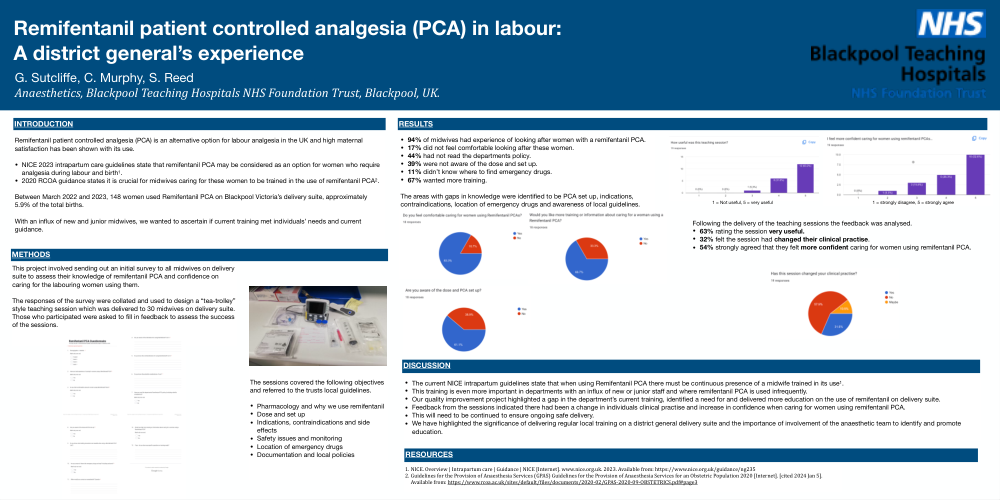
This project involved sending out an initial survey to all midwives on delivery suite to assess their knowledge of remifentanil PCA and confidence on caring for the labouring women using them.
The responses of the survey were collated and used to design a “tea-trolley” style teaching session which was delivered to 30 midwives on delivery suite. Those who participated were asked to fill in feedback to assess the success of the sessions.
The sessions covered the following objectives and referred to the trusts local guidelines.
- Pharmacology and why we use remifentanil
- Dose and set up
- Indications, contraindications and side effects
- Safety issues and monitoring
- Location of emergency drugs
- Documentation and local policies
RESULTS
- 94% of midwives had experience of looking after women with a remifentanil PCA.
- 17% did not feel comfortable looking after these women.
- 44% had not read the departments policy.
- 39% were not aware of the dose and set up.
- 11% didn’t know where to find emergency drugs.
- 67% wanted more training.
The areas with gaps in knowledge were identified to be PCA set up, indications, contraindications, location of emergency drugs and awareness of local guidelines.
Following the delivery of the teaching sessions the feedback was analysed.
- 63% rating the session very useful.
- 32% felt the session had changed their clinical practise.
- 54% strongly agreed that they felt more confident caring for women using remifentanil PCA.
DISCUSSION
- The current NICE intrapartum guidelines state that when using Remifentanil PCA there must be continuous presence of a midwife trained in its use1.
- This training is even more important in departments with an influx of new or junior staff and where remifentanil PCA is used infrequently.
- Our quality improvement project highlighted a gap in the department’s current training, identified a need for and delivered more education on the use of remifentanil on delivery suite.
- Feedback from the sessions indicated there had been a change in individuals clinical practise and increase in confidence when caring for women using remifentanil PCA.
- This will need to be continued to ensure ongoing safe delivery.
- We have highlighted the significance of delivering regular local training on a district general delivery suite and the importance of involvement of the anaesthetic team to identify and promote education.
RESOURCES
- NICE. Overview | Intrapartum care | Guidance | NICE [Internet]. www.nice.org.uk. 2023. Available from: https://www.nice.org.uk/guidance/ng235
- Guidelines for the Provision of Anaesthesia Services (GPAS) Guidelines for the Provision of Anaesthesia Services for an Obstetric Population 2020 [Internet]. [cited 2024 Jan 5]. Available from: https://www.rcoa.ac.uk/sites/default/files/documents/2020-02/GPAS-2020-09-OBSTETRICS.pdf#page3