150 posters, 16 sessions, 294 authors, 70 institutions
ePostersLive by SciGen Technologies S.A. All rights reserved.
Obstetric Anaesthesia Annual Scientific Meeting 2024
Thursday 9 - Friday 10 May 2024, Birmingham

6300197
Trauma Caesarean Section- an example of excellent interdisciplinary working
Poster Presenter
Authors
Affiliations
null,
Part of Topic
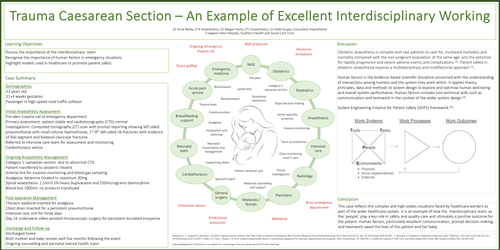
Trauma Caesarean Section – An Example of Excellent Interdisciplinary Working
Dr Anne Bailey, ST4 Anaesthetics, Dr Megan Harty, CT1 Anaesthetics, Dr Nidhi Gupta, Consultant Anaesthetist
Craigavon Area Hospital, Southern Health and Social Care Trust.
Learning objectives:
Discuss the importance of the interdisciplinary team
Recognise the importance of human factors in emergency situations
Highlight models used in healthcare to promote patient safety
Case summary:
Demographics
32 years old
31+4 weeks gestation
Passenger in high-speed road traffic collision
Initial Anaesthetic Assessment
Pre-alert trauma call to emergency department
Primary assessment: patient stable and cardiotocography (CTG) normal
Investigations: Computed tomography (CT) scan with prompt reporting showing left sided pneumothorax with small volume haemothorax, 1st-9th left-sided rib fractures with evidence of flail segment and bilateral clavicular fractures
Referred to intensive care team for assessment and monitoring
Cardiothoracic advice
Ongoing Anaesthetic Management
Category 1 caesarean section due to abnormal CTG
Patient transferred to obstetric theatre
Arterial line for invasive monitoring and blood gas sampling
Analgesia- ketamine titrated to maximum 30mg
Spinal anaesthesia- 2.5ml 0.5% heavy bupivacaine and 250micrograms diamorphine
Blood loss 1000ml- no products transfused
Post-operative Management
Thoracic epidural inserted for analgesia
Chest drain inserted for a persistent pneumothorax
Intensive care unit for three days
Day 24 underwent video-assisted thoracoscopic surgery for persistent loculated empyema
Discharge and Follow-up
Discharged home
Both mother and baby remain well five months following the event
Ongoing counselling and perinatal mental health input
Discussion:
Obstetric anaesthesia is complex with two patients to care for; increased morbidity and mortality compared with the non-pregnant population of the same age; and the potential for rapidly progressive and severe adverse events and complications (1). Patient safety in obstetric anaesthesia requires a multidisciplinary and multifactorial approach (2).
Human factors is the evidence based scientific discipline concerned with the understanding of interactions among humans and the system they work within. It applies theory, principles, data and methods to system design to explore and optimise human well-being and overall system performance. Human factors includes non-technical skills such as communication and teamwork in the context of the wider system design (3).
System Engineering Initative for Patient Safety (SEIPS) framework (4):
Conclusion:
This case reflects the complex and high-stakes situations faced by healthcare workers as part of the wider healthcare system. It is an example of how the interdisciplinary team, as the ‘people’, play a key role in safety and quality care and ultimately a positive outcome for the patient. Human factors, particularly excellent communication, prompt decision making, and teamwork saved the lives of this patient and her baby.