150 posters, 16 sessions, 294 authors, 70 institutions
ePostersLive by SciGen Technologies S.A. All rights reserved.
Obstetric Anaesthesia Annual Scientific Meeting 2024
Thursday 9 - Friday 10 May 2024, Birmingham

6287690
16 minutes to delivery; Clinical decision making and human factors during maternal cardiac arrest and resuscitative hysterotomy.
Poster Presenter
Authors
Part of Topic
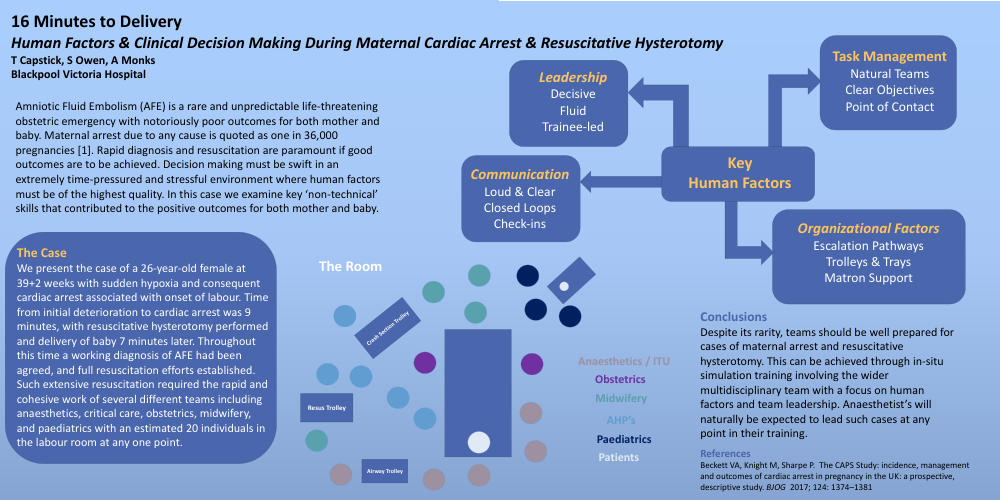
16 Minutes to Delivery
Human Factors & Clinical Decision Making During Maternal Cardiac Arrest & Resuscitative Hysterotomy
T Capstick, S Owen, A Monks
Blackpool Victoria Hospital
Amniotic Fluid Embolism (AFE) is a rare and unpredictable life-threatening obstetric emergency with notoriously poor outcomes for both mother and baby. Maternal arrest due to any cause is quoted as one in 36,000 pregnancies [1]. Rapid diagnosis and resuscitation are paramount if good outcomes are to be achieved. Decision making must be swift in an extremely time-pressured and stressful environment where human factors must be of the highest quality. In this case we examine key ‘non-technical’ skills that contributed to the positive outcomes for both mother and baby.
We present the case of a 26-year-old female at 39+2 weeks with sudden hypoxia and consequent cardiac arrest associated with onset of labour. Time from initial deterioration to cardiac arrest was 9 minutes, with resuscitative hysterotomy performed and delivery of baby 7 minutes later. Throughout this time a working diagnosis of AFE had been agreed, and full resuscitation efforts established. Such extensive resuscitation required the rapid and cohesive work of several different teams including anaesthetics, critical care, obstetrics, midwifery, and paediatrics with an estimated 20 individuals in the labour room at any one point.
Conclusions
Despite its rarity, teams should be well prepared for cases of maternal arrest and resuscitative hysterotomy. This can be achieved through in-situ simulation training involving the wider multidisciplinary team with a focus on human factors and team leadership. Anaesthetist’s will naturally be expected to lead such cases at any point in their training.