150 posters, 16 sessions, 294 authors, 70 institutions
ePostersLive by SciGen Technologies S.A. All rights reserved.
Obstetric Anaesthesia Annual Scientific Meeting 2024
Thursday 9 - Friday 10 May 2024, Birmingham

6301395
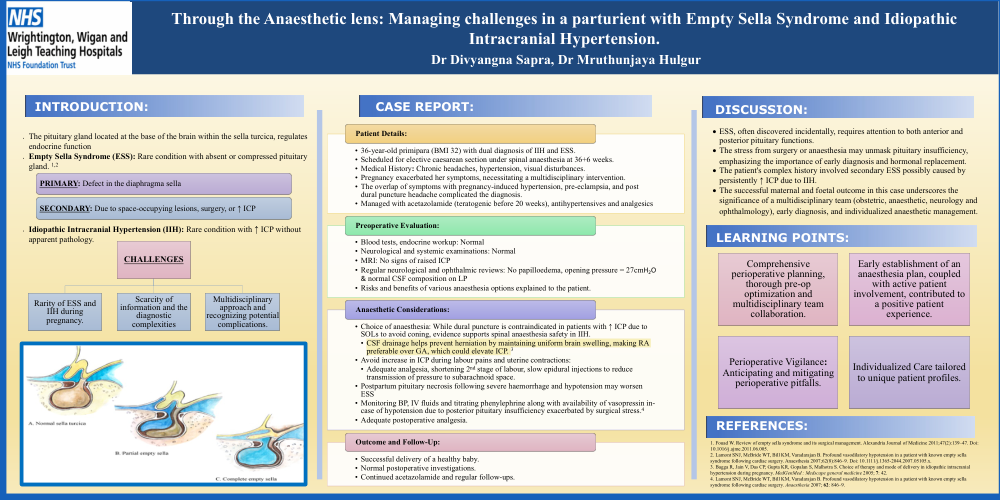
Through the Anaesthetic lens: Managing challenges in a parturient with empty sella syndrome and idiopathic intracranial hypertension.
Poster Presenter
Authors
Part of Topic
Through the Anaesthetic lens: Managing challenges in a parturient with Empty Sella Syndrome and Idiopathic Intracranial Hypertension.
(Dr Divyangna Sapra, Dr Mruthunjaya Hulgur)
Introduction:
- The pituitary gland located at the base of the brain within the sella turcica, regulates endocrine function
- Empty Sella Syndrome (ESS): Rare condition with absent or compressed pituitary gland.1,2
Primary: Defect in the diaphragma sella,
Secondary: Due to space-occupying lesions, surgery, or ↑ ICP
- Idiopathic Intracranial Hypertension (IIH): Rare condition with ↑ ICP without apparent pathology.
Challenges:
- Rarity of ESS and IIH during pregnancy.
- Scarcity of information and the diagnostic complexities
- Multidisciplinary approach and recognizing potential complications.
Case report:
- Patient Details:
- 36-year-old primipara (BMI 32) with dual diagnosis of IIH and ESS.
- Scheduled for elective caesarean section under spinal anaesthesia at 36+6 weeks.
- Medical History: Chronic headaches, hypertension, visual disturbances
- Pregnancy exacerbated her symptoms, necessitating a multidisciplinary intervention.
- The overlap of symptoms with pregnancy-induced hypertension, pre-eclampsia, and post dural puncture headache complicated the diagnosis.
- Managed with acetazolamide (teratogenic before 20 weeks), antihypertensives and analgesics
- Preoperative Evaluation:
- Blood tests, endocrine workup: Normal
- Neurological and systemic examinations: Normal
- MRI: No signs of raised ICP
- Regular neurological and ophthalmic reviews: No papilloedema, opening pressure = 27cmH2O & normal CSF composition on LP
- Risks and benefits of various anaesthesia options explained to patient.
- Anaesthetic Considerations:
- Choice of anaesthesia: While dural puncture is contraindicated in patients with ↑ ICP from SOLs to avoid coning, evidence supports spinal anaesthesia safety in IIH.
- CSF drainage helps prevent herniation by maintaining uniform brain swelling, making RA preferable over GA, which could elevate ICP.3
- Avoid increase in ICP during labour pains and uterine contractions:
- Adequate analgesia, shortening 2nd stage of labour, slow epidural injections to reduce transmission of pressure to subarachanoid space.
- Postpartum pituitary necrosis following severe haemorrahge and hypotension may worsen ESS
- Monitoring BP, IV fluids and titrating phenylephrine along with availability of vasopressin in-case of hypotension due to posterior pituitary insufficiency exacerbated by surgical stress.4
- Adequate postoperative analgesia.
- Outcome and Follow-Up:
- Successful delivery of a healthy baby.
- Normal postoperative investigations.
- Continued acetazolamide and regular follow-ups.
Discussion:
- ESS, often discovered incidentally, requires attention to both anterior and posterior pituitary functions.
- The stress from surgery or anaesthesia may unmask pituitary insufficiency, emphasizing the importance of early diagnosis and hormonal replacement.
- The patient's complex history involved secondary ESS possibly caused by persistently ↑ ICP due to IIH.
- The successful maternal and foetal outcome in this case underscores the significance of a multidisciplinary team (obstetric, anaesthetic, neurology and ophthalmology), early diagnosis, and individualized anaesthetic management.
Learning Points:
- Comprehensive perioperative planning and thorough pre-op optimization and multidisciplinary team collaboration.
- Early establishment of an anaesthesia plan, coupled with active patient involvement, contributed to a positive patient experience.
- Perioperative Vigilance: Anticipating and mitigating perioperative pitfalls.
- Individualized Care tailored to unique patient profiles.
References:
1. Fouad W. Review of empty sella syndrome and its surgical management. Alexandria Journal of Medicine 2011;47(2):139–47. Doi: 10.1016/j.ajme.2011.06.005.
2. Lamont SNJ, McBride WT, Bill KM, Varadarajan B. Profound vasodilatory hypotension in a patient with known empty sella syndrome following cardiac surgery. Anaesthesia 2007;62(8):846–9. Doi: 10.1111/j.1365-2044.2007.05105.x.
3. Bagga R, Jain V, Das CP, Gupta KR, Gopalan S, Malhotra S. Choice of therapy and mode of delivery in idiopathic intracranial hypertension during pregnancy. MedGenMed : Medscape general medicine 2005; 7: 42.
4. Lamont SNJ, McBride WT, Bill KM, Varadarajan B. Profound vasodilatory hypotension in a patient with known empty sella syndrome following cardiac surgery. Anaesthesia 2007; 62: 846–9.