150 posters, 16 sessions, 294 authors, 70 institutions
ePostersLive by SciGen Technologies S.A. All rights reserved.
Obstetric Anaesthesia Annual Scientific Meeting 2024
Thursday 9 - Friday 10 May 2024, Birmingham

6301361
Burnt out Takayasu arteritis and its challenges
Poster Presenter
Authors
Part of Topic
Takayasu arteritis is an idiopathic rare large vessel primary vasculitis, more frequently occurring in females of child bearing age. It causes granulomatous inflammation of the aorta and its large branches. This can cause:
After the active inflammatory phase, the disease becomes ‘burnt-out’ causing occlusion in the aorta or large vessels. Most patients have prenatal counselling to discourage pregnancy.Life expectancy: median age at death is 38 years(i). There are few case reports regardingmanagement of pregnancy in this cohort
A 31 year old female (P1+1) presented to our preassessment clinic for delivery planning. Herobstetric history included a termination ofpregnancy at 9 weeks and an ELCS at 32+5weeks gestation due to severe maternal hypertension (when her disease was mild). She was diagnosed with Takayasu arteritis at the age of 20, stopped immunosuppression five years ago and was in the burnt out stage of her disease.
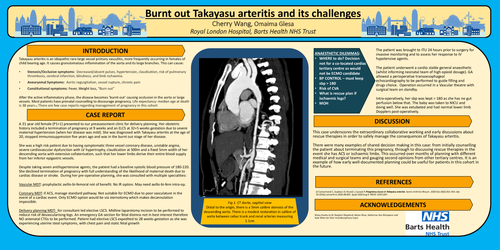
She was a high risk patient due to having symptomatic three vessel coronary disease,unstable angina, severe cardiovascular dysfunction with LV hypertrophy, claudication at 500m and a fixed 5mm width of her descending aorta with extensive collaterisation, such that her lower limbs derive their entire blood supply from her inferior epigastric vessels.
Despite taking seven antihypertensive agents, the patient had a baseline systolic blood pressure of 180-220. She declined termination of pregnancy with full understanding of the likelihood of maternal death due to cardiac disease or stroke. During her pre-operative planning, she was consulted with multiple specialities:
Vascular MDT: prophylactic axillo-bi-femoral not of benefit. No IR option. May need axillo-bi-fem intra-op.
Coronary MDT: if ACS, manage standard pathway. Not suitable for ECMO due to poor vasculature in the event of a cardiac event. Only ECMO option would be via sternotomy which makes decannulation impossible.
Delivery planning MDT: for consultant led elective LSCS. Midline laparotomy incision to be performed to reduce risk of devascularisinglegs. An emergency GA section for fetal distress not in best interest therefore NO antenatal CTGs to be performed. Patient had elective LSCS expedited to 28 weeks gestation as she was experiencing uterine steal symptoms, with chest pain and static fetalgrowth
ANAESTHETIC DILEMMAS: