150 posters, 16 sessions, 294 authors, 70 institutions
ePostersLive by SciGen Technologies S.A. All rights reserved.
Obstetric Anaesthesia Annual Scientific Meeting 2024
Thursday 9 - Friday 10 May 2024, Birmingham

6301084
Maternal neurological deterioration in a home birth
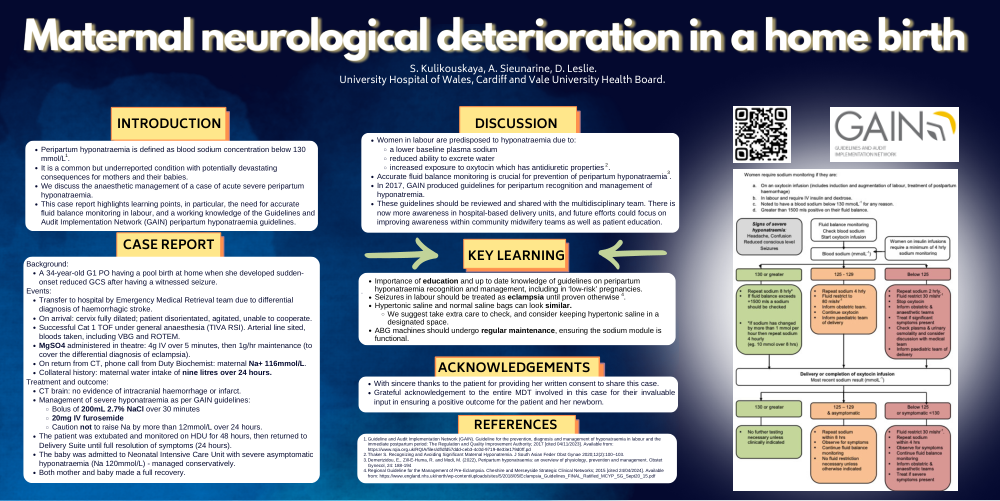
Poster Presenter
Part of Topic
INTRODUCTION
Peripartum hyponatraemia is defined as blood sodium concentration below 130 mmol/L.
It is a common but underreported condition with potentially devastating consequences for mothers and their babies.
We discuss the anaesthetic management of a case of acute severe peripartum hyponatraemia.
This case report highlights learning points, in particular, the need for accurate fluid balance monitoring in labour, and a working knowledge of the Guidelines and Audit Implementation Network (GAIN) peripartum hyponatraemia guidelines.
CASE REPORT
Background:
A 34-year-old G1 PO having a pool birth at home when she developed sudden- onset reduced GCS after having a witnessed seizure.
Events:
Transfer to hospital by Emergency Medical Retrieval team due to differential diagnosis of haemorrhagic stroke.
On arrival: cervix fully dilated; patient disorientated, agitated, unable to cooperate.Successful Cat 1 TOF under general anaesthesia (TIVA RSI). Arterial line sited, bloods taken, including VBG and ROTEM.
MgSO4 administered in theatre: 4g IV over 5 minutes, then 1g/hr maintenance (to cover the differential diagnosis of eclampsia).
On return from CT, phone call from Duty Biochemist: maternal Na+ 116mmol/L.
Collateral history: maternal water intake of nine litres over 24 hours. Treatment and outcome:
CT brain: no evidence of intracranial haemorrhage or infarct.
Management of severe hyponatraemia as per GAIN guidelines:
Bolus of 200mL 2.7% NaCl over 30 minutes
20mg IV furosemide
Caution not to raise Na by more than 12mmol/L over 24 hours.
The patient was extubated and monitored on HDU for 48 hours, then returned to Delivery Suite until full resolution of symptoms (24 hours).
The baby was admitted to Neonatal Intensive Care Unit with severe asymptomatic hyponatraemia (Na 120mmol/L) - managed conservatively.
Both mother and baby made a full recovery.
DISCUSSION
Accurate fluid balance monitoring is crucial for prevention of peripartum hyponatraemia.
In 2017, GAIN produced guidelines for peripartum recognition and management of hyponatremia.
These guidelines should be reviewed and shared with the multidisciplinary team. There is now more awareness in hospital-based delivery units, and future efforts could focus on improving awareness within community midwifery teams as well as patient education.
KEY LEARNING
Importance of education and up to date knowledge of guidelines on peripartum hyponatraemia recognition and management, including in ‘low-risk’ pregnancies. Seizures in labour should be treated as eclampsia until proven otherwise.
Hypertonic saline and normal saline bags can look similar.
We suggest take extra care to check, and consider keeping hypertonic saline in a designated space.
ABG machines should undergo regular maintenance, ensuring the sodium module is functional.
ACKNOWLEDGEMENTS
With sincere thanks to the patient for providing her written consent to share this case. Grateful acknowledgement to the entire MDT involved in this case for their invaluable input in ensuring a positive outcome for the patient and her newborn.
REFERENCES
1.Guideline and Audit Implementation Network (GAIN). Guideline for the prevention, diagnosis and management of hyponatraemia in labour and the immediate postpartum period: The Regulation and Quality Improvement Authority; 2017 [cited 04/11/2023]. Available from: https://www.rqia.org.uk/RQIA/files/df/dfd57ddd-ceb3-4c0d-9719-8e33e179d0ff.pd
2.Thaker S. Recognizing and Avoiding Significant Maternal Hyponatremia. J South Asian Feder Obst Gynae 2020;12(2):100–103.
3.Demertzidou, E., Zill-E-Huma, R. and Modi, M. (2022), Peripartum hyponatraemia: an overview of physiology, prevention and management. Obstet Gynecol, 24: 188-194
4.Regional Guideline for the Management of Pre-Eclampsia. Cheshire and Merseyside Strategic Clinical Networks; 2015 [cited 24/04/2024]. Available from: https://www.england.nhs.uk/north/wp-content/uploads/sites/5/2018/05/Eclampsia_Guidelines_FINAL_Ratified_MCYP_SG_Sept20_15.pdf