150 posters, 16 sessions, 294 authors, 70 institutions
ePostersLive by SciGen Technologies S.A. All rights reserved.
Obstetric Anaesthesia Annual Scientific Meeting 2024
Thursday 9 - Friday 10 May 2024, Birmingham

6300769
Bleomycin and oxygen: A toxic relationship?
Poster Presenter
Authors
Part of Topic
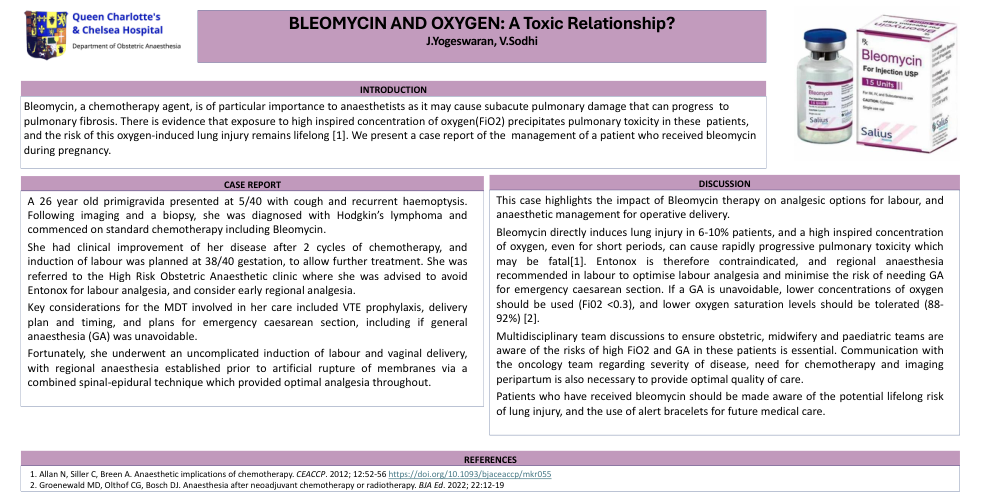
BLEOMYCIN AND OXYGEN: A Toxic Relationship?
J.Yogeswaran, V.Sodhi
Introduction
Bleomycin, a chemotherapy agent, is of particular importance to anaesthetists as it may cause subacute pulmonary damage that can progress topulmonary fibrosis. There is evidence that exposure to high inspired concentration of oxygen(FiO2) precipitates pulmonary toxicity in these patients,and the risk of this oxygen-induced lung injury remains lifelong [1]. We present a case report of the management of a patient who received bleomycinduring pregnancy.
Case Report
A 26 year old primigravida presented at 5/40 with cough and recurrent haemoptysis. Following imaging and a biopsy, she was diagnosed with Hodgkin’s lymphoma and commenced on standard chemotherapy including Bleomycin.
She had clinical improvement of her disease after 2 cycles of chemotherapy, and induction of labour was planned at 38/40 gestation, to allow further treatment. She was referred to the High Risk Obstetric Anaesthetic clinic where she was advised to avoid Entonox for labour analgesia, and consider early regional analgesia.
Key considerations for the MDT involved in her care included VTE prophylaxis, delivery plan and timing, and plans for emergency caesarean section, including if general anaesthesia (GA) was unavoidable.
Fortunately, she underwent an uncomplicated induction of labour and vaginal delivery, with regional anaesthesia established prior to artificial rupture of membranes via a combined spinal-epidural technique which provided optimal analgesia throughout.
Discussion
This case highlights the impact of Bleomycin therapy on analgesic options for labour, and anaesthetic management for operative delivery.
Bleomycin directly induces lung injury in 6-10% patients, and a high inspired concentration of oxygen, even for short periods, can cause rapidly progressive pulmonary toxicity which may be fatal[1]. Entonox is therefore contraindicated, and regional anaesthesia recommended in labour to optimise labour analgesia and minimise the risk of needing GA for emergency caesarean section. If a GA is unavoidable, lower concentrations of oxygen should be used (Fi02 <0.3), and lower oxygen saturation levels should be tolerated (88-92%) [2].
Multidisciplinary team discussions to ensure obstetric, midwifery and paediatric teams are aware of the risks of high FiO2 and GA in these patients is essential. Communication with the oncology team regarding severity of disease, need for chemotherapy and imaging peripartum is also necessary to provide optimal quality of care.
Patients who have received bleomycin should be made aware of the potential lifelong risk of lung injury, and the use of alert bracelets for future medical care.
References
1. Allan N, Siller C, Breen A. Anaesthetic implications of chemotherapy. CEACCP. 2012; 12:52-56 https://doi.org/10.1093/bjaceaccp/mkr055
2. Groenewald MD, Olthof CG, Bosch DJ. Anaesthesia after neoadjuvant chemotherapy or radiotherapy. BJA Ed. 2022; 22:12-19