150 posters, 16 sessions, 294 authors, 70 institutions
ePostersLive by SciGen Technologies S.A. All rights reserved.
Obstetric Anaesthesia Annual Scientific Meeting 2024
Thursday 9 - Friday 10 May 2024, Birmingham

6300042
Massive goitre causing severe tracheal stenosis in pregnancy
Poster Presenter
Authors
Affiliations
Part of Topic
Massive goitre causing severe tracheal stenosis in pregnancy
Dr Ben Goodman, Dr Michael Robson, Dr Adam Shonfeld
Department of Anaesthesia, St George’s Hospital, London
Introduction
An enlarged thyroid may present airway management difficulties due to tracheal compression or deviation, and if longstanding may be associated with tracheomalacia. We present the case of a 29-year-old primiparous patient who developed a multinodular goitre in pregnancy causing significant airway compression.
Case Report
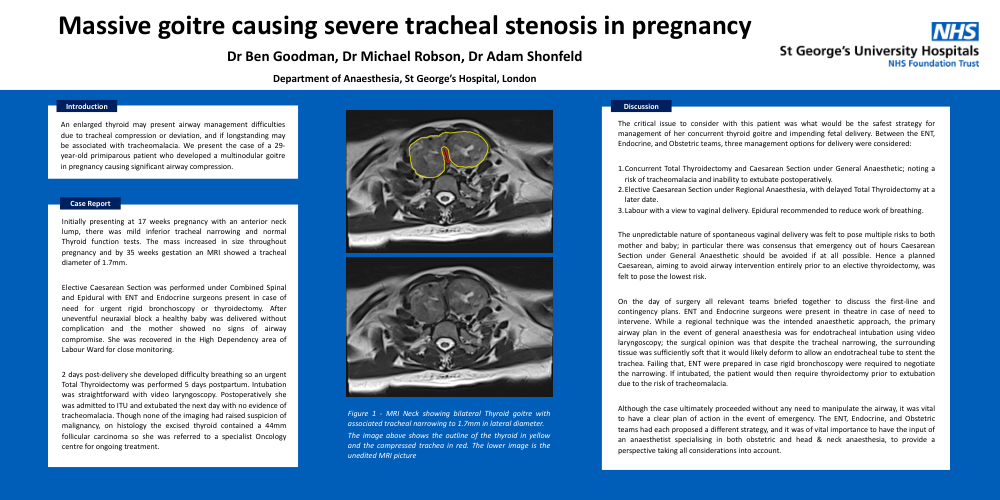
Initially presenting at 17 weeks pregnancy with an anterior neck lump, there was mild inferior tracheal narrowing and normal Thyroid function tests. The mass increased in size throughout pregnancy and by 35 weeks gestation an MRI showed a tracheal diameter of 1.7mm. Elective Caesarean Section was performed under Combined Spinal and Epidural with ENT and Endocrine surgeons present in case of need for urgent rigid bronchoscopy or thyroidectomy. After uneventful neuraxial block a healthy baby was delivered without complication and the mother showed no signs of airway compromise. She was recovered in the High Dependency area of Labour Ward for close monitoring.
2 days post-delivery she developed difficulty breathing so an urgent Total Thyroidectomy was performed 5 days postpartum. Intubation was straightforward with video laryngoscopy. Postoperatively she was admitted to ITU and extubated the next day with no evidence of tracheomalacia. Though none of the imaging had raised suspicion of malignancy, on histology the excised thyroid contained a 44mm follicular carcinoma so she was referred to a specialist Oncology centre for ongoing treatment.
Discussion
The critical issue to consider with this patient was what would be the safest strategy for management of her concurrent thyroid goitre and impending fetal delivery. Between the ENT, Endocrine, and Obstetric teams, three management options for delivery were considered:
1.Concurrent Total Thyroidectomy and Caesarean Section under General Anaesthetic; noting a
risk of tracheomalacia and inability to extubate postoperatively.
2.Elective Caesarean Section under Regional Anaesthesia, with delayed Total Thyroidectomy at a
later date.
3.Labour with a view to vaginal delivery. Epidural recommended to reduce work of breathing.
The unpredictable nature of spontaneous vaginal delivery was felt to pose multiple risks to both mother and baby; in particular there was consensus that emergency out of hours Caesarean Section under General Anaesthetic should be avoided if at all possible. Hence a planned Caesarean, aiming to avoid airway intervention entirely prior to an elective thyroidectomy, was felt to pose the lowest risk.
On the day of surgery all relevant teams briefed together to discuss the first-line and contingency plans. ENT and Endocrine surgeons were present in theatre in case of need to intervene. While a regional technique was the intended anaesthetic approach, the primary airway plan in the event of general anaesthesia was for endotracheal intubation using video laryngoscopy; the surgical opinion was that despite the tracheal narrowing, the surrounding tissue was sufficiently soft that it would likely deform to allow an endotracheal tube to stent the trachea. Failing that, ENT were prepared in case rigid bronchoscopy were required to negotiate the narrowing. If intubated, the patient would then require thyroidectomy prior to extubation due to the risk of tracheomalacia.
Although the case ultimately proceeded without any need to manipulate the airway, it was vital to have a clear plan of action in the event of emergency. The ENT, Endocrine, and Obstetric teams had each proposed a different strategy, and it was of vital importance to have the input of an anaesthetist specialising in both obstetric and head & neck anaesthesia, to provide a perspective taking all considerations into account.