150 posters, 16 sessions, 294 authors, 70 institutions
ePostersLive by SciGen Technologies S.A. All rights reserved.
Obstetric Anaesthesia Annual Scientific Meeting 2024
Thursday 9 - Friday 10 May 2024, Birmingham

6285543
Baby, it's cold outside - a case of cold urticaria on labour ward
Poster Presenter
Authors
Affiliations
Part of Topic
Introduction
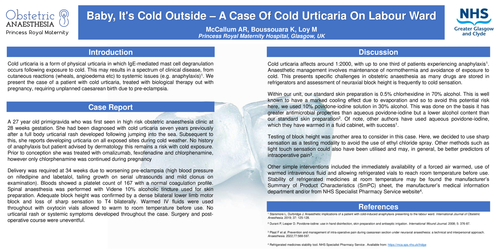
Cold urticaria is a form of physical urticaria in which IgE-mediated mast cell degranulation occurs following exposure to cold. This may results in a spectrum of clinical disease, from cutaneous reactions (wheals, angioedema etc) to systemic issues (e.g. anaphylaxis)1. We present the case of a patient with cold urticaria, treated with biological therapy out with pregnancy, requiring unplanned caesarean birth due to pre-eclampsia.
Case Report
A 27 year old primigravida who was first seen in high risk obstetric anaesthesia clinic at 28 weeks gestation. She had been diagnosed with cold urticaria seven years previously after a full body urticarial rash developed following jumping into the sea. Subsequent to this, she reports developing urticaria on all exposed sites during cold weather. No history of anaphylaxis but patient advised by dermatology this remains a risk with cold exposure. Prior to conception she was treated with omalizumab, fexofenadine and chlorphenamine, however only chlorphenamine was continued during pregnancy
Delivery was required at 34 weeks due to worsening pre-eclampsia (high blood pressure on nifedipine and labetalol, tailing growth on serial ultrasounds and mild clonus on examination). Bloods showed a platelet count of 167 with a normal coagulation profile. Spinal anaesthesia was performed with Videne 10% alcoholic tincture used for skin preparation. Adequate block height was confirmed by a dense bilateral lower limb motor block and loss of sharp sensation to T4 bilaterally. Warmed IV fluids were used throughout with oxytocin vials allowed to warm to room temperature before use. No urticarial rash or systemic symptoms developed throughout the case. Surgery and post-operative course were uneventful.
Discussion
Cold urticaria affects around 1:2000, with up to one third of patients experiencing anaphylaxis1. Anaesthetic management involves maintenance of normothermia and avoidance of exposure to cold. This presents specific challenges in obstetric anaesthesia as many drugs are stored in refrigerators and assessment of neuraxial block height is frequently to cold sensation.
Within our unit, our standard skin preparation is 0.5% chlorhexidine in 70% alcohol. This is well known to have a marked cooling effect due to evaporation and so to avoid this potential risk here, we used 10% povidone-iodine solution in 30% alcohol. This was done on the basis it has greater antimicrobial properties than aqueous povidone-iodine but a lower alcohol content than our standard skin preparation2. Of note, other authors have used aqueous povidone-iodine, which they have warmed in a fluid cabinet, with success1.
Testing of block height was another area to consider in this case. Here, we decided to use sharp sensation as a testing modality to avoid the use of ethyl chloride spray. Other methods such as light touch sensation could also have been utilised and may, in general, be better predictors of intraoperative pain3.
Other simple interventions included the immediately availability of a forced air warmed, use of warmed intravenous fluid and allowing refrigerated vials to reach room temperature before use. Stability of refrigerated medicines at room temperature may be found the manufacturer’s Summary of Product Characteristics (SmPC) sheet, the manufacturer’s medical information department and/or from NHS Specialist Pharmacy Service website4.
References
1 Starsmore L, Durbridge J. Anaesthetic implications of a patient with cold-induced anaphylaxis presenting to the labour ward. International Journal of Obstetric Anesthesia. 2019; 37: 125-128.
2 Durani P, Leaper D. Povidone-iodine: use in hand disinfection, skin preparation and antiseptic irrigation. International Wound Journal. 2008; 5: 376-87.
3 Plaat F et al. Prevention and management of intra-operative pain during caesarean section under neuraxial anaesthesia: a technical and interpersonal approach. Anaesthesia. 2022;77:588-597.
4 Refrigerated medicines stability tool. NHS Specialist Pharmacy Service . Available from: https://mca.sps.nhs.uk/fridge