191 posters, 5 topics, 20 sessions, 393 authors, 116 institutions
ePostersLive by SciGen Technologies S.A. All rights reserved.
Obstetric Anaesthesia Annual Scientific Meeting 2023
18 - 19 May, 2023 | EICC Edinburgh

5809840
Management of emergency caesarean delivery and decompressive craniectomy for parturient with an acutely decompensated glioblastoma
Poster Presenter
Authors
Affiliations
Part of Topic
Case report
Intraoperative considerations for emergency caesarean for the parturient
with an acutely decompensated glioblastoma – a case report
Chachlani M, Skelly JR, Turnbull C. Nuffield Department of Anaesthesia, Oxford University Hospitals NHS Foundation Trust
CASE REPORT
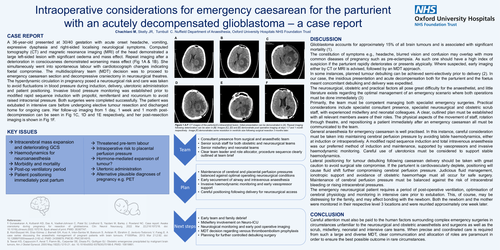
A 36-year-old presented at 30/40 gestation with acute onset headache, vomiting, expressive dysphasia and right-sided localising neurological symptoms. Computed tomography (CT) and magnetic resonance imaging (MRI) of the head demonstrated a large left-sided lesion with significant oedema and mass effect. Repeat imaging after a deterioration in consciousness demonstrated worsening mass effect (Fig 1A & 1B). She simultaneously went into spontaneous labour with cardiotocograph changes indicating foetal compromise. The multidisciplinary team (MDT) decision was to proceed to emergency caesarean section and decompressive craniectomy in neurosurgical theatres. The hyperdynamic circulation in pregnancy posed a neurosurgical risk and care was taken to avoid fluctuations in blood pressure during induction, delivery, uterotonic administration and patient positioning. Invasive blood pressure monitoring was established prior to modified rapid sequence induction with propofol, remifentanil and rocuronium to avoid raised intracranial pressure. Both surgeries were completed successfully. The patient was extubated in intensive care before undergoing elective tumour resection and discharged home for ongoing care. Her follow-up imaging from 1 day, 1 week and 1 month post-decompression can be seen in Fig 1C, 1D and 1E respectively, and her post-resection imaging is shown in Fig 1F.
DISCUSSION
Glioblastoma accounts for approximately 15% of all brain tumours and is associated with significant mortality (1).
The constitution of symptoms e.g., headache, blurred vision and confusion may overlap with more common diseases of pregnancy such as pre-eclampsia. As such one should have a high index of suspicion if the parturient rapidly deteriorates or presents atypically. Where suspected, early imaging either by CT or MRI is advised, followed by an MDT approach.
In some instances, planned tumour debulking can be achieved semi-electively prior to delivery (2). In our case, the insidious presentation and acute decompensation both for the parturient and the foetus meant concomitant debulking and delivery was expedited.
The neurosurgical, obstetric and practical factors all pose great difficulty for the anaesthetist, and little literature exists regarding the optimal management of an emergency scenario where both operations must be done immediately (3)
Primarily, the team must be competent managing both specialist emergency surgeries. Practical considerations include specialist consultant presence, specialist neurosurgical and obstetric scrub staff, with experienced midwifery and neonatal colleagues. A clear, outlined plan must be established with all relevant members aware of their roles. The physical aspects of the movement of staff, rotation through theatre, and repositioning a patient immediately after an emergency caesarean all must be communicated to the team.
General anaesthesia for emergency caesarean is well practised. In this instance, careful consideration must be taken into maintaining cerebral perfusion pressure by avoiding labile haemodynamics, either at induction or intraoperatively. A modified rapid sequence induction and total intravenous anaesthesia was our preferred method of induction and maintenance, supported by vasopressors and invasive haemodynamic monitoring. Careful use of uterotonics must be considered to support stable haemodynamics.
Lateral positioning for tumour debulking following caesarean delivery should be taken with great caution to avoid surgical site compromise. If the parturient is cardiovascularly deplete, positioning will cause fluid shift further compromising cerebral perfusion pressure. Judicious fluid management, ionotropic support and avoidance of obstetric haemorrhage must all occur for safe surgery. Maintenance of cerebral perfusion pressure must be balanced against the risk of intracerebral bleeding or rising intracerebral pressures.
The emergency neurosurgical patient requires a period of post-operative ventilation, optimisation of cerebral physiology and monitoring in intensive care prior to extubation. This, of course, may be distressing for the family, and may affect bonding with the newborn. Both the newborn and the mother were monitored in their respective level 3 locations and were reunited approximately one week later.
CONCLUSION
Careful attention must also be paid to the human factors surrounding complex emergency surgeries in circumstances unfamiliar to the neurosurgical and obstetric anaesthetists and surgeons as well as the scrub, midwifery, neonatal and intensive care teams. When precise and coordinated care is required from such a large and diverse MDT, clear communication and allocation of roles are paramount in order to ensure the best possible outcome in rare circumstances.