191 posters, 5 topics, 20 sessions, 393 authors, 116 institutions
ePostersLive by SciGen Technologies S.A. All rights reserved.
Obstetric Anaesthesia Annual Scientific Meeting 2023
18 - 19 May, 2023 | EICC Edinburgh

5750966
Ileo-femoral thrombosis presenting at term: a case report
Poster Presenter
Authors
Affiliations
Part of Topic
Case report
ILEO-FEMORAL THROMBISIS PRESENTING AT TERM: A CASE REPORT
Introduction
The guidance on management of ileo-femoral thrombosis (IFT) in late pregnancy is limited1. We present a case of a pregnancy complicated by an acute IFT at term.
Case Report
An 18-year-old primigravida with an uncomplicated pregnancy, BMI 23,presented to a district hospital at 37+6 weeks with calf swelling. USS
Doppler showed a large le IFT with proximal extension. Therapeutic anticoagulation with low molecular weight heparin (LMWH) was started. She was transferred to a tertiary centre for consideration of an inferior vena cava (IVC) filter because of her late gestation, high risk of embolus and complex ongoing anticoagulation requirements.
An IVC filter was inserted whilst fully anticoagulated following discussion between interventional radiologists, haematologists, obstetricians, and anaesthetists. LMWH was then stopped, and IV unfractionated heparin commenced. High dose IV heparin was needed because of heparin resistance of pregnancy1, to achieve a target aPTT ratio of 2. Labour was induced to minimise the time the IVC filter was in situ and protamine was made available. A plan for labour analgesia with remifentanil PCA was made with the option of an epidural 6-hours after discontinuing IV heparin.
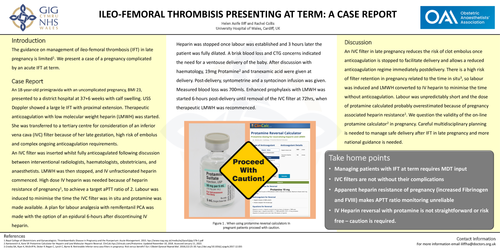
Heparin was stopped once labour was established and 3 hours later the patient was fully dilated. A brisk blood loss and CTG concerns indicated the need for a ventouse delivery of the baby. After discussion with haematology, 19mg Protamine2 and tranexamic acid were given at delivery. Post-delivery, syntometrine and a syntocinon infusion was given. Measured blood loss was 700mls. Enhanced prophylaxis with LMWH was started 6-hours post-delivery until removal of the IVC filter at 72hrs, when therapeutic LMWH was recommenced.
Discussion
An IVC filter in late pregnancy reduces the risk of clot embolus once anticoagulation is stopped to facilitate delivery and allows a reduced anticoagulation regime immediately postdelivery. There is a high risk of filter retention in pregnancy related to the time in situ3, so labour was induced and LMWH converted to IV heparin to minimise the time without anticoagulation. Labour was unpredictably short and the dose of protamine calculated probably overestimated because of pregnancy associated heparin resistance1. We question the validity of the on-line protamine calculator2 in pregnancy. Careful multidisciplinary planning is needed to manage safe delivery after IFT in late pregnancy and more national guidance is needed.
Take home points
-
Managing patients with IFT at term requires MDT input
-
IVC filters are not without their complications
-
Apparent heparin resistance of pregnancy (increased Fibrinogen and FVIII) makes APTT ratio monitoring unreliable
-
IV Heparin reversal with protamine is not straight forward or risk free – caution is required.
References