191 posters, 5 topics, 20 sessions, 393 authors, 116 institutions
ePostersLive by SciGen Technologies S.A. All rights reserved.
Obstetric Anaesthesia Annual Scientific Meeting 2023
18 - 19 May, 2023 | EICC Edinburgh

5798353
Management of a parturient with a "filamin-A mutation".
Poster Presenter
Authors
Affiliations
Part of Topic
Case report
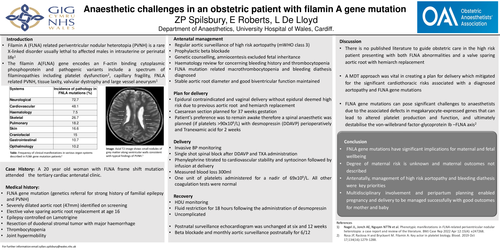
•Filamin A (FLNA) related periventricular nodular heterotopia (PVNH) is a rare X-linked disorder usually lethal to affected males in intrauterine or perinatal life1
•The filamin A(FLNA) gene encodes an F-actin binding cytoplasmic phosphoprotein and pathogenic variants include a spectrum of filaminopathies including platelet dysfunction2, capillary fragility, FNLA related PVNH, tissue laxity, valvular dystrophy and large vessel aneurysm1
Case History: A 20 year old woman with FLNA frame shift mutation attended the tertiary cardiac antenatal clinic.
Medical history:
•FLNA gene mutation (genetics referral for strong history of familial epilepsy and PVNH)
•Severely dilated aortic root (47mm) identified on screening
•Elective valve sparing aortic root replacement at age 16
•Epilepsy controlled on Lamotrigine
•Resection of duodenal stromal tumor with major haemorrhage
•Thrombocytopenia
•Joint hypermobility
Antenatal management
•Regular aortic surveillance of high risk aortopathy (mWHO class 3)
•Prophylactic beta blockade
•Genetic counselling, amniocentesis excluded fetal inheritance
•Haematology review for concerning bleeding history and thrombocytopenia
•FLNA mutation related macrothrombocytopenia and bleeding diathesis diagnosed
•Stable aortic root diameter and good biventricular function maintained
Plan for delivery
•Epidural contraindicated and vaginal delivery without epidural deemed high risk due to previous aortic root and hemiarch replacement
•Caesarean section planned for 37 weeks gestation
•Patient’s preference was to remain awake therefore a spinal anaesthetic was planned (if platelets >90x109/L) with desmopressin (DDAVP) perioperatively and Tranexamic acid for 2 weeks
Delivery
•Invasive BP monitoring
•Single shot spinal block after DDAVP and TXA administration
•Phenylephrine titrated to cardiovascular stability and syntocinon followed by infusion at delivery
•Measured blood loss 300ml
•One unit of platelets administered for a nadir of 69x109/L. All other coagulation tests were normal
Recovery
•HDU monitoring
•Fluid restriction for 18 hours following the administration of desmopressin
•Uncomplicated
•Postnatal surveillance echocardiogram was unchanged at six and 12 weeks
•Beta blockade and monthly aortic surveillance postnatally for 6/12
Discussion
•There is no published literature to guide obstetric care in the high risk patient presenting with both FLNA abnormalities and a valve sparing aortic root with hemiarch replacement
•
•A MDT approach was vital in creating a plan for delivery which mitigated for the significant cardiothoracic risks associated with a diagnosed aortopathy and FLNA gene mutations
•
•FLNA gene mutations can pose significant challenges to anaesthetists due to the associated defects in megakaryocyte-expressed genes that can lead to altered platelet production and function, and ultimately destabilise the von-willebrand factor-glycoprotein Ib –FLNA axis2
Conclusion
•FNLA gene mutations have significant implications for maternal and fetal wellbeing
•Degree of maternal risk is unknown and maternal outcomes not described
•Antenatally, management of high risk aortopathy and bleeding diathesis were key priorities
•Multidisciplinary involvement and peripartum planning enabled pregnancy and delivery to be managed successfully with good outcomes for mother and baby