191 posters, 5 topics, 20 sessions, 393 authors, 116 institutions
ePostersLive by SciGen Technologies S.A. All rights reserved.
Obstetric Anaesthesia Annual Scientific Meeting 2023
18 - 19 May, 2023 | EICC Edinburgh

5784903
Coagulopathy and placentitis complicating COVID-19 infection in the obstetric population
Poster Presenter
Authors
Affiliations
Part of Topic
Case report
Coagulopathy and placentitis complicating COVID-19 infection in the obstetric population
J Nicholas1, F Roberts1, A Wise2, A Blair3, R Mathers3, R Jones4
Sheffield Teaching Hospitals NHS Foundation Trust1, NHS Lothian2, Southern Health & Social Care Trust3, Cwn Taf Morgannwg University Health Board4
Introduction
Coagulopathy and its complications, both thrombotic and haemorrhagic, have been reported in association with SARS-CoV-2 (COVID-19) infection[1].
UK national guidance relating to the pregnancy-specific risks of COVID-19 place little emphasis on the potential for haemorrhagic complications[2]. We present a UK-wide series of 14 obstetric patients with mild or asymptomatic COVID-19 infection in whom coagulopathy occurred, the majority of whom had histological evidence of COVID placentitis.
Case Series
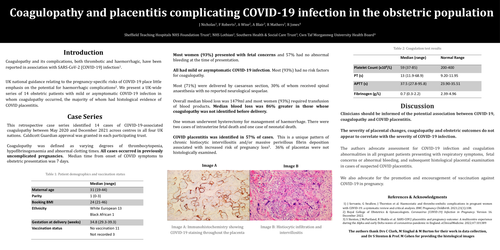
This retrospective case series identified 14 cases of COVID-19-associated coagulopathy between May 2020 and December 2021 across centres in all four UK nations. Caldicott Guardian approval was granted in each participating trust.
Coagulopathy was defined as varying degrees of thrombocytopenia, hypofibrinogenaemia and abnormal clotting times. All cases occurred in previously uncomplicated pregnancies. Median time from onset of COVID symptoms to obstetric presentation was 7 days.
Most women (93%) presented with fetal concerns and 57% had no abnormal bleeding at the time of presentation.
All had mild or asymptomatic COVID-19 infection. Most (93%) had no risk factors for coagulopathy.
Most (71%) were delivered by caesarean section, 30% of whom received spinal anaesthesia with no reported neurological sequelae.
Overall median blood loss was 1479ml and most women (93%) required transfusion of blood products. Median blood loss was 86% greater in those whose coagulopathy was not identified before delivery.
One woman underwent hysterectomy for management of haemorrhage. There were two cases of intrauterine fetal death and one case of neonatal death.
COVID placentitis was identified in 57% of cases. This is a unique pattern of chronic histiocytic intervillositis and/or massive perivillous fibrin deposition associated with increased risk of pregnancy loss[3]. 36% of placentas were not histologically examined.
Discussion
Clinicians should be informed of the potential association between COVID-19, coagulopathy and COVID placentitis.
The severity of placental changes, coagulopathy and obstetric outcomes do not appear to correlate with the severity of COVID-19 infection.
The authors advocate assessment for COVID-19 infection and coagulation abnormalities in all pregnant patients presenting with respiratory symptoms, fetal concerns or abnormal bleeding, and subsequent histological placental examination in cases of suspected COVID placentitis.
We also advocate for the promotion and encouragement of vaccination against COVID-19 in pregnancy.
References & Acknowledgments
1) J Servante, G Swallow, J Thornton et al. Haemostatic and thrombo-embolic complications in pregnant women with COVID-19: a systematic review and critical analysis. BMC Pregnancy Childbirth. 2021;21(1):108.
2) Royal College of Obstetrics & Gynaecologists. Coronavirus (COVID-19) Infection in Pregnancy. Version 16. December 2022.
3) S Stenton, J McPartland, R Shukla et al. SARS-COV2 placentitis and pregnancy outcome: A multicentre experience during the Alpha and early Delta waves of coronavirus pandemic in England. eClinicalMedicine. 2022;47:101389
The authors thank Drs C Clark, M Singhal & M Burton for their work in data collection, and Dr S Stenton & Prof. M Cohen for providing the histological images