191 posters, 5 topics, 20 sessions, 393 authors, 116 institutions
ePostersLive by SciGen Technologies S.A. All rights reserved.
Obstetric Anaesthesia Annual Scientific Meeting 2023
18 - 19 May, 2023 | EICC Edinburgh

5795728
Anuria during labour
Poster Presenter
Authors
Affiliations
Part of Topic
Case report
ANURIA DURING LABOUR.
Introduction
Hydronephrosis is commonly seen in pregnancy as a result of ureteric dilatation from progesterone-induced smooth muscle relaxation and mechanical pressure of the gravid uterus on the ureters. It is not usually associated with renal impairment. We present the case of acute bilateral ureteric obstruction during labour causing an acute kidney injury (AKI) and requiring delivery via caesarean birth.
Due to the increased blood volume and capacity of the collecting system serum creatinine levels fall throughout pregnancy. In the third trimester an AKI is defined as a serum creatinine above 77μmol/L [1]. The causes for AKI in pregnancy are hypertensive disorders of pregnancy, hypovolaemia, sepsis, cardiovascular collapse and obstruction [2]. In this case, a rare case of obstruction is described.
Written consent has been obtained for presentation and publication.
Case Report
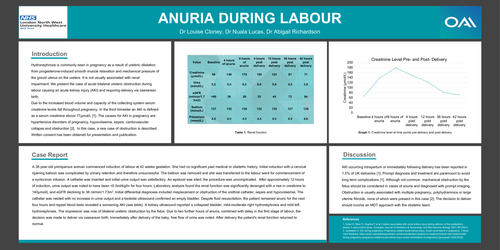
A 38 year-old primiparous woman commenced induction of labour at 42 weeks gestation. She had no significant past medical or obstetric history. Initial induction with a cervical ripening balloon was complicated by urinary retention and therefore unsuccessful. The balloon was removed and she was transferred to the labour ward for commencement of a syntocinoninfusion. A catheter was inserted and initial urine output was satisfactory. An epidural was sited; the procedure was uncomplicated. After approximately 12 hours of induction, urine output was noted to have been <0.5ml/kg/hr for four hours. Laboratory analysis found the renal function was significantly deranged with a rise in creatinine to 140μmol/L and eGFR declining to 38 ml/min/1.73m2. Initial differential diagnoses included misplacement or obstruction of the urethral catheter, sepsis and hypovolaemia. The catheter was resited with no increase in urine output and a bedside ultrasound confirmed an empty bladder. Despite fluid resuscitation, the patient remained anuric for the next four hours and repeat blood tests revealed a worsening AKI (see table). A kidney ultrasound reported a collapsed bladder, mild-moderate right hydronephrosis and mild left hydronephrosis. The impression was now of bilateral ureteric obstruction by the fetus. Due to two further hours of anuria, combined with delay in the first stage of labour, the decision was made to deliver via caesarean birth. Immediately after delivery of the baby, free flow of urine was noted. After delivery the patient's renal function returned to normal.
Discussion
AKI occurring intrapartum or immediately following delivery has been reported in 1.5% of UK deliveries [1]. Prompt diagnosis and treatment are paramount to avoid long term complications [1]. Although not common, mechanical obstruction by the fetus should be considered in cases of anuria and diagnosed with prompt imaging. Obstruction is usually associated with multiple pregnancy, polyhydramnios or large uterine fibroids, none of which were present in this case [2]. The decision to deliver should involve an MDT approach with the obstetric team.
References
Coles H, Steer P, Hughes P et al. Factors associated with acute kidney injury during delivery or the postpartum period: A case control study. European Journal of Obstetrics & Gynecology and Reproductive Biology 2021; 61:200-4.
2. Jeyabalan A. AKI during pregnancy, Pregnancy-related acute kidney injury, Acute renal failure in pregnancy. Critical Care Medicine.https://www.cancertherapyadvisor.com/home/decision-support-in-medicine/critical-care-medicine/aki-during-pregnancy-pregnancy-related-acute-kidney-injury-acute-renal-failure-in-pregnancy/ [accessed 10/04/2023]