191 posters, 5 topics, 20 sessions, 393 authors, 116 institutions
ePostersLive by SciGen Technologies S.A. All rights reserved.
Obstetric Anaesthesia Annual Scientific Meeting 2023
18 - 19 May, 2023 | EICC Edinburgh

5795266
Headache with a twist- Amrita A, Sabaretnam S, Hickson M-Luton & Dunstable University Hospital, Bedfordshire NHS Foundation trust.
Poster Presenter
Authors
Part of Topic
Case report
Introduction
Labour epidural is the gold standard for labour analgesia. Loss of resistance for saline or air is utilised to identify the epidural space. According to OAA or NAP 3, it is associated with 1 in 100 incidence of post dural puncture headache (PDPH). Pneumocephalus is a very rare complication when air is used.
Case report
35-year-old lady underwent difficult epidural placement for labour analgesia using loss of resistance for air technique. Intra partum analgesia was good and uneventful. On removal of epidural catheter, she complained of severe frontal headache. It was of sudden onset and associated with photophobia, neck spasms. It worsened with supine position and movement. She was treated with analgesics which didn’t improve the severity.
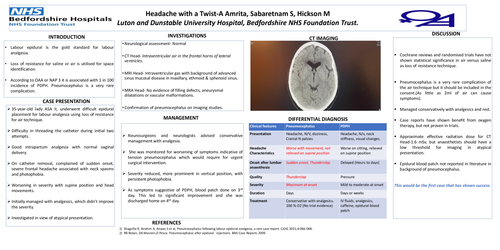
CT imaging of head was done as the headache didn’t fit the classical picture of PDPH. It showed intraventricular air in the frontal horns of lateral ventricles. MRI and MRA imaging confirmed the pneumocephalus. Neurosurgeons and neurologists advised conservative management with analgesia. She was monitored for worsening of symptoms indicative of tension pneumocephalus which would require for urgent surgical intervention.
Though the severity of headache decreased, it became more prominent in vertical position with persistent photophobia. As the symptoms were suggestive of PDPH, epidural blood patch was done on 3rd day after long discussion. This led to significant improvement in symptoms and she was discharged home on 4th day.
Discussion
Cochrane reviews and randomised controlled trials have not shown statistical significance in air versus saline in the loss of resistance technique for identification of the epidural space. Pneumocephalus is a very rare complication of the air technique but it should be included in the consent. As little as 2mls of air can cause significant symptoms when dura is breached.
Headache due to pneumocephalus is not relieved by supine position and worst with movements. It is an immediate thunderclap headache which is maximum at onset. Pneumocephalus is treated conservatively with analgesia. There is no benefit from Caffeine consumption. There are case reports showing benefit from oxygen therapy but not tested in trials.
Approximate effective radiation dose of CT brain is 1.6 mSv. But obstetric anaesthetists should have low threshold for imaging in cases of headache which have atypical presentation.
Epidural blood patch has not been reported in the literature in background of pneumocephalus and PDPH. This would be the first case that has shown success.