191 posters, 5 topics, 20 sessions, 393 authors, 116 institutions
ePostersLive by SciGen Technologies S.A. All rights reserved.
Obstetric Anaesthesia Annual Scientific Meeting 2023
18 - 19 May, 2023 | EICC Edinburgh

5795089
Subdural spinal haematoma following presumed inadvertent subdural catheter placement during labour: a case report
Poster Presenter
Authors
Affiliations
Part of Topic
Case report
Subdural spinal haematoma following presumed inadvertent subdural catheter placement during labour: a case report
Introduction
Subdural spinal haematoma following a subdurally-placed epidural catheter insertion during labour is a very rare neurological complication of attempted epidural analgesia. We present the case of a patient who developed severe back pain, headache, and neck stiffness following a presumed subdurally-placed epidural catheter with a subsequent subdural spinal haematoma confirmed on imaging.
Case Report
A 64kg fit and well 26-year-old (then G2P1) requested epidural analgesia for labour. Initial attempts at L3/4 failed, but attempts at L2/3 yielded loss of resistance with no cerebrospinal fluid through a 16G Tuohy needle. The catheter was passed, and a meniscal drop was observed, with no blood on aspiration of the catheter. A test dose produced a good analgesic response afterfifteen minutes.
The epidural initially provided good analgesia, but required multiple anaesthetic reviews due to the variable height and somewhat unilateral block, necessitating frequent top-ups. The patient had a vaginal birth of a healthy baby seven hours post procedure, and the epidural catheter was removed at half an hour after birth.
Post Procedure:
Three hours after epidural removal, the patient developed severe lower back pain, headache and stiff neck.
- Neurological examination: normal lower limb sensation and power.
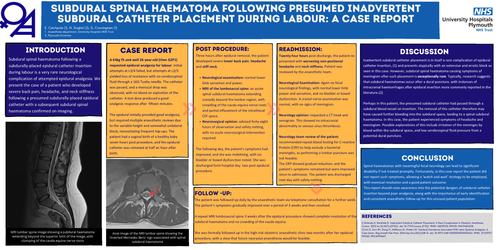
- MRI of the lumbosacral spine: an acute spinal subdural haematoma extending cranially beyond the lumbar region, with crowding of the cauda equina nerve roots and partial effacement of the intrathecal CSF space.
- Neurosurgical opinion: advised forty-eight hours of observation and safety netting, with no acute neurosurgical intervention required.
The following day, the patient’s symptoms had improved, and she was mobilising, with no bladder or bowel dysfunction noted. She was discharged form hospital daytwo post epidural procedure.
Readmission:
Twenty-four hours post-discharge, the patient re-presented with worsening non-positional headache and neck stiffness. Patient was reviewed by the anaesthetic team.
Neurological Examination: Again no focal neurological findings, with normal lower limb power and sensation, and no bladder or bowel dysfunction. A cranial nerve examination was normal, with no signs of meningism.
Neurology opinion: requested a CT head and venogram. This showed no intracranial abnormality or venous sinus thrombosis.
Neurology team review of the patient: recommended repeat blood testing for C-reactive Protein (CRP) to help exclude a bacterial meningitis, as performing a lumbar puncture was not feasible.
The CRP showed gradual reduction, and the patient’s symptoms remained but were improved since re-admission. The patient was discharged next day with safety-netting.
Follow -up:
The patient was followed up daily by the anaesthetic team via telephone consultation for a further week. The patient’s symptoms gradually improved over a period of 3 weeks and then resolved.
A repeat MRI lumbosacral spine 3 weeks after the epidural procedure showed complete resolution of the subdural haematoma and no crowding of the cauda equina.
She was formally followed up in the high-risk obstetric anaesthetic clinic two months after her epidural procedure, with a view that future neuraxial anaesthesia would be feasible.
Discussion
Inadvertent subdural catheter placement is in itself a rare complication of epidural catheter insertion, (1) and presents atypically with an extensive and erratic block as seen in this case. However, subdural spinal haematoma causing symptoms of meningism after such placement is exceptionally rare. Typically, research suggests that subdural haematomas occur after a dural puncture, with instances of intracranial haemorrhages after epidural insertion more commonly reported in the literature.(2)
Perhaps in this patient, the presumed subdural catheter had passed through a subdural blood vessel on insertion. The removal of this catheter therefore may have caused further bleeding into the subdural space, leading to a spinal subdural haematoma. In this case, the patient experienced symptoms of headache and meningism. Possible explanations of this include irritation of the meninges by blood within the subdural space, and low cerebrospinal fluid pressure from a potential dural puncture.
Conclusion
Spinal haematomas with meaningful focal neurology can lead to significant disability if not treated promptly. Fortunately, in this case report the patient did not report such symptoms, allowing a ‘watch and wait’ strategy to be employed, with eventual resolution and a good patient outcome.
This report should raise awareness into the potential dangers of subdural catheter insertion beyond poor analgesia, along with the importance of early identification and consistent anaesthetic follow-up for this unusual patient population.
References
1) Alshoubi A, Newhide D. Inadvertent Subdural Catheter Placement: A Rare Complication in Obstetric Anesthesia. Cureus. 2022 Jul 25;14(7):e27252. doi: 10.7759/cureus.27252. PMID: 36039231; PMCID: PMC9402258.
2) Lim G, Zorn JM, Dong YJ, DeRenzo JS, Waters JH. Subdural Hematoma Associated With Labor Epidural Analgesia: A Case Series. Reg Anesth Pain Med. 2016 Sep-Oct;41(5):628-31. doi: 10.1097/AAP.0000000000000455. PMID: 27512937; PMCID: PMC4993647.