191 posters, 5 topics, 20 sessions, 393 authors, 116 institutions
ePostersLive by SciGen Technologies S.A. All rights reserved.
Obstetric Anaesthesia Annual Scientific Meeting 2023
18 - 19 May, 2023 | EICC Edinburgh

5791993
Severe obstetric coagulopathy following placental abruption requiring 18 g fibrinogen concentrate.
Poster Presenter
Authors
Affiliations
Part of Topic
Case report
Introduction
Placental abruption can cause a rapidly progressive coagulopathy. This as due to simultaneous consumption and depletion of clotting factors, leading to systemic hyperfibrinolysis1. This case describes early detection of severe coagulopathy following suspected abruption, which facilitated prompt decision making around the mode of anaesthesia and early replacement of clotting factors.
Case report
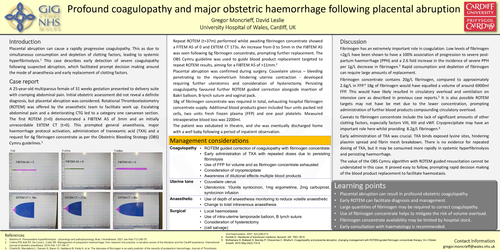
A 25-year-old multiparous female of 31 weeks gestation presented to delivery suite with cramping abdominal pain. Initial obstetric assessment did not reveal a definite diagnosis, but placental abruption was considered. Rotational Thromboelastometry (ROTEM) was offered by the anaesthetic team to facilitate work up. Escalating abdominal pain and a deteriorating CTG led to a category one caesarean section. The first ROTEM (t=0) demonstrated a FIBTEM A5 of 3mm and an initially unrecordable EXTEM CT (t=0). This prompted general anaesthesia, major haemorrhage protocol activation, administration of tranexamic acid (TXA) and a request for 6g fibrinogen concentrate as per the Obstetric Bleeding Strategy (OBS) Cymru guidelines.2
Repeat ROTEM (t=37m) performed whilst awaiting the first 6g of fibrinogen concentrate showed a FITEM A5 of 0 and EXTEM CT 173s. An increase from 0 to 5mm in the FIBTEM A5 was seen following 6g fibrinogen concentrate, prompting further fibrinogen concentrate to be requested. The OBS Cymru guideline was used to guide product replacement targeted to repeat ROTEM results, aiming for a FIBTEM A5 of >11mm.2
Placental abruption was confirmed during surgery. Couvelaire uterus developed requiring repeated uterotonics and consideration of hysterectomy. Persisting coagulopathy favoured further replacement of fibrinogen alongside insertion of Bakri balloon, B-lynch suture and vaginal pack.
18g of fibrinogen concentrate was required in total, exhausting hospital fibrinogen concentrate supply. Additional blood products given included four units packed red cells, two units fresh frozen plasma (FFP) and one pool platelets. Measured intraoperative blood loss was 2200ml.
The patient was extubated in theatre, and was eventually discharged home with a well baby following a period of inpatient observation.
Discussion
Fibrinogen has an extremely important role in coagulation. Low levels of fibrinogen <2g/L have been shown to have a 100% association of progression to severe post-partum haemorrhage (PPH) and a 2.6 fold increase in the incidence of severe PPH per 1g/L decrease in fibrinogen.3 Rapid consumption and depletion of fibrinogen can require large amounts of replacement.
Fibrinogen concentrate contains 20g/L fibrinogen, compared to approximately 2.6g/L in FFP.4 18g of fibrinogen would have equalled a volume of around 6900ml FFP. This would have likely resulted in circulatory overload and ventilation on intensive care as described in previous case reports.5 It is also possible ROTEM targets may not have be met due to the lower concentration, prompting administration of further blood products compounding circulatory overload.
Caveats to fibrinogen concentrate include the lack of significant amounts of other clotting factors, especially factors VIII, XIII and vWF. Cryoprecipitate may have an important role here whilst providing 8.2g/L fibrinogen.4
Early administration of TXA was crucial. TXA binds exposed lysine sites, hindering plasmin spread and fibrin mesh breakdown. There is no evidence for repeated dosing of TXA, but it may be consumed more rapidly in systemic hyperfibrinolysis and persisting haemorrhage.
The value of the OBS Cymru algorithm with ROTEM guided resuscitation cannot be understated in this case. It proved easy to follow, prompting rapid decision making of the blood product replacement to facilitate haemostasis.