191 posters, 5 topics, 20 sessions, 393 authors, 116 institutions
ePostersLive by SciGen Technologies S.A. All rights reserved.
Obstetric Anaesthesia Annual Scientific Meeting 2023
18 - 19 May, 2023 | EICC Edinburgh

5787715
Maternal subarachnoid haemorrhage secondary to post-partum pre-eclampsia: a case series
Poster Presenter
Authors
Affiliations
Part of Topic
Case report
Maternal subarachnoid haemorrhage secondary to post partum pre-eclampsia: a case series
Introduction
MBRRACE 2022 reported mortality from hypertensive disease to be 4 times higher than in 2012-2014 [1]. We report 2 cases of postpartum headache subsequently diagnosed with maternal subarachnoid haemorrhage (SAH) secondary to post-partum hypertension due to pre-eclampsia.
Case 1
A 28-year-old was admitted from clinic at 38+3 weeks gestation with falling platelets and abnormal liver function tests. Her protein:creatinine ratio was 88mg/mmol and she was diagnosed with HELLP syndrome. She underwent uncomplicated category 2 emergency caesarean section under spinal anaesthetic. Medical history included moderate learning disability and previous treatment with perindopril stopped 4 years previously. Blood pressure (BP) throughout pregnancy and postnatally until discharge was normal.
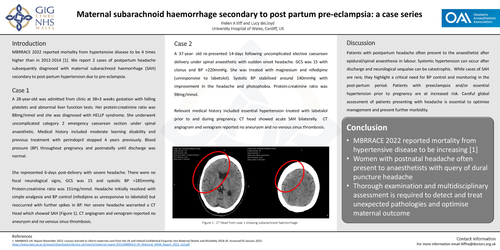
She represented 6-days post-delivery with severe headache. There were no focal neurological signs, GCS was 15 and systolic BP >185mmHg. Protein:creatinine ratio was 151mg/mmol. Headache initially resolved with simple analgesia and BP control (nifedipine as unresponsive to labetalol) but reoccurred with further spikes in BP. Her severe headache warranted a CT Head which showed SAH (Figure 1). CT angiogram and venogram reported no aneurysm and no venous sinus thrombosis.
Case 2
A 37-year- old re-presented 14-days following uncomplicated elective caesarean delivery under spinal anaesthetic with sudden onset headache. GCS was 15 with clonus and BP >220mmHg. She was treated with magnesium and nifedipine (unresponsive to labetolol). Systolic BP stabilised around 140mmHg with improvement in the headache and photophobia. Protein:creatinine ratio was 98mg/mmol.
Relevant medical history included essential hypertension treated with labetalol prior to and during pregnancy. CT head showed acute SAH bilaterally. CT angiogram and venogram reported no aneurysm and no venous sinus thrombosis.
Discussion
Patients with postpartum headache often present to the anaesthetist after epidural/spinal anaesthesia in labour. Systemic hypertension can occur after discharge and neurological sequalae can be catastrophic. While cases of SAH are rare, they highlight a critical need for BP control and monitoring in the post-partum period. Patients with preeclampsia and/or essential hypertension prior to pregnancy are at increased risk. Careful global assessment of patients presenting with headache is essential to optimise management and prevent further morbidity.
Conclusion