191 posters, 5 topics, 20 sessions, 393 authors, 116 institutions
ePostersLive by SciGen Technologies S.A. All rights reserved.
Obstetric Anaesthesia Annual Scientific Meeting 2023
18 - 19 May, 2023 | EICC Edinburgh

5818113
Neurosarcoidosis in pregnancy
Poster Presenter
Authors
Affiliations
Part of Topic
Case report
Introduction
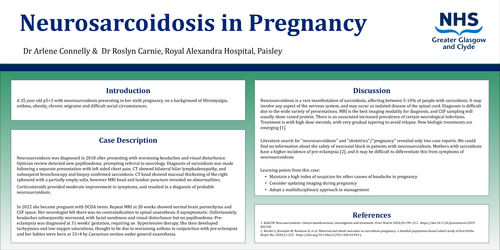
A 35 year old p5+3 with neurosarcoidosis presenting in her sixth pregnancy, on a background of fibromyalgia, asthma, obesity, chronic migraine and difficult social circumstances.
Case Description
Neurosarcoidosis was diagnosed in 2018 after presenting with worsening headaches and visual disturbance. Optician review detected new papilloedema, prompting referral to neurology. Diagnosis of sarcoidosis was made following a separate presentation with left sided chest pain. CT showed bilateral hilar lymphadenopathy, and subsequent bronchoscopy and biopsy confirmed sarcoidosis. CT head showed mucosal thickening of the right sphenoid with a partially empty sella, however MRI head and lumbar puncture revealed no abnormalities.
Corticosteroids provided moderate improvement in symptoms, and resulted in a diagnosis of probable neurosarcoidosis.
In 2022 she became pregnant with DCDA twins. Repeat MRI at 20 weeks showed normal brain parenchyma and CSF space. Her neurologist felt there was no contraindication to spinal anaesthesia if asymptomatic. Unfortunately, headaches subsequently worsened, with facial numbness and visual disturbance but no papilloedema. Pre-eclampsia was diagnosed at 31 weeks’ gestation, requiring an hypertensive therapy. She then developed tachypnoea and low oxygen saturations, thought to be due to worsening asthma in conjunction with pre-eclampsia and her babies were born at 33+4 by Caesarean section under general anaesthesia.
Discussion
Neurosarcoidosis is a rare manifestation of sarcoidosis, affecting between 5-10% of people with sarcoidosis. It may involve any aspect of the nervous system, and may occur as isolated disease of the spinal cord. Diagnosis is difficult due to the wide variety of presentations. MRI is the best imaging modality for diagnosis, and CSF sampling will usually show raised protein. There is an associated increased prevalence of certain neurological infections. Treatment is with high dose steroids, with very gradual tapering to avoid relapse. New biologic treatments are emerging [1].
Literature search for "neurosarcoidosis" and "obstetrics"/"pregnancy" revealed only two case reports. We could find no information about the safety of neuraxial block in patients with neurosarcoidosis. Mothers with sarcoidosis have a higher incidence of pre-eclampsia [2], and it may be difficult to differentiate this from symptoms of neurosarcoidosis.
Learning points from this case:
References
1. Kidd DP. Neurosarcoidosis: clinical manifestations, investigation and treatment. PractNeurol 2020;20:199–212. https://doi:10.1136/practneurol-2019-002349
2. Köcher L, Rossides M, Remaeus K, et al. Maternal and infant outcomes in sarcoidosis pregnancy: a Swedish population-based cohort study of first births. Respir Res. 2020;21:225. https://doi.org/10.1186/s12931-020-01493-y