191 posters, 5 topics, 20 sessions, 393 authors, 116 institutions
ePostersLive by SciGen Technologies S.A. All rights reserved.
Obstetric Anaesthesia Annual Scientific Meeting 2023
18 - 19 May, 2023 | EICC Edinburgh

5798890
Little women - coming up short on equality?
Poster Presenter
Authors
Affiliations
Part of Topic
Case report
Little women – coming up short on equality?
H. Jothiraj, R. Sun, K. Russell, V. Sodhi. Queen Charlotte's and Chelsea Hospitals, London
Introduction:
Dwarfism is defined as a failure to attain a height of 148 cm by adulthood affecting approximately one in 25,000. This presents multiple clinical and non-clinical challenges within the obstetric setting. We present two cases of pregnant women living with dwarfism. Consent was obtained from both patients discussed.
Case Report:
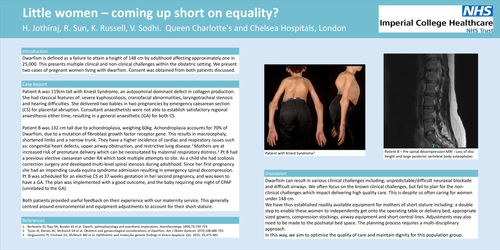
Patient A was 119cm tall with Kniest Syndrome, an autosominal dominant defect in collagen production. She had classical features of: severe kyphoscoliosis, craniofacial abnormalities, laryngotracheal stenosis and hearing difficulties. She delivered two babies in two pregnancies by emergency caesarean section (CS) for placental abruption. Consultant anaesthetists were not able to establish satisfactory regional anaesthesia either time, resulting in a general anaesthetic (GA) for both CS.
Patient B was 132 cm tall due to achondroplasia, weighing 60kg. Achondroplasia accounts for 70% of Dwarfism, due to a mutation of fibroblast growth factor receptor gene. This results in macrocephaly, shortened limbs and a narrow trunk. They have a higher incidence of cardiac and respiratory issues such as: congenital heart defects, upper airway obstruction, and restrictive lung disease.1 Mothers are at increased risk of premature delivery which can be necessitated by maternal respiratory distress.2 Pt B had a previous elective caesarean under RA which took multiple attempts to site. As a child she had scoliosis correction surgery and developed multi-level spinal stenosis during adulthood. Since her first pregnancy she had an impending cauda equina syndrome admission resulting in emergency spinal decompression. Pt B was scheduled for an elective CS at 37 weeks gestation in her second pregnancy, and was keen to have a GA. The plan was implemented with a good outcome, and the baby requiring one night of CPAP (unrelated to the GA).
Both patients provided useful feedback on their experience with our maternity service. This generally centred around environmental and equipment adjustments to account for their short stature.
Discussion:
Dwarfism can result in various clinical challenges including; unpredictable/difficult neuraxial blockade and difficult airways. We often focus on the known clinical challenges, but fail to plan for the non-clinical challenges which impact delivering high quality care. This is despite us often caring for women under 148 cm.
We have thus established readily available equipment for mothers of short stature including: a double step to enable these women to independently get onto the operating table or delivery bed, appropriate sized gowns, compression stockings, airway equipment and short central lines. Adjustments may also need to be made to the postnatal bed space. The planning process requires a multi-disciplinary approach.
In this way, we aim to optimise the quality of care and maintain dignity for this population group.
References: