191 posters, 5 topics, 20 sessions, 393 authors, 116 institutions
ePostersLive by SciGen Technologies S.A. All rights reserved.
Obstetric Anaesthesia Annual Scientific Meeting 2023
18 - 19 May, 2023 | EICC Edinburgh

5798391
Successful MDT management of stress induced anaphylaxis complicating labour and delivery
Poster Presenter
Part of Topic
Case report
Stress Induced Anaphylaxis Complicating Labour
Dr L Wibmer (STR in Obstetrics and Gynaecology), Dr F Roberts (Consultant Obstetric Anaesthetist), Dr V Stern (Consultant Obstetrician)
Introduction
- Stress induced anaphylaxis (SIA) is a rare form of anaphylaxis with a similar mechanism to exercise induced anaphylaxis.
- Exercise induced anaphylaxis (EIA) was first reported by Sheffer and Austin in 1980 and is attributed to a lowering of the mast cell degranulation threshold leading to a release of histamine and other mediators (1).
- There remains very little in the literature regarding the safest mode of delivery for patients with exercise induced anaphylaxis, and nil for patients with stress induced anaphylaxis.
Background
- 29 year old primigravida attended labour ward for an induction of labour at 41+1 weeks gestation
- She had a past medical history of SIA, having had 2 previous hospital admissions, requiring intramuscular adrenaline and admission.
- Extensive immunological investigation including routine blood tests, complement studies and tryptase had attributed the cause of her anaphylaxis to stress.
- She had an anaesthetic review early in her pregnancy, at which point her placenta was low lying, and therefore planning centered around elective caesarean section delivery.
- Plan was made for intravenous hydrocortisone and chlorphenamine pre-operatively.
- Although subsequently, third trimester ultrasound confirmed that the placenta was clear of the internal os, therefore re-orientation of delivery planning towards vaginal birth was now considered.
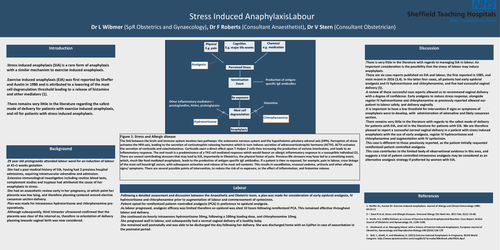
Figure 1: Stress and Allergic disease
The link between the brain and immune system involves two pathways: the autonomic nervous system and the hypothalamic-pituitary-adrenal axis (HPA). Perception of stress activates the HPA axis, leading to the secretion of corticotrophin releasing hormone which in turn induces secretion of adrenocorticotrophic hormone (ACTH). ACTH activates the secretion of corticoids and catecholamines. Corticoids exert a direct effect upon T-Helper 2 cells thus increasing the production of various interleukins, and leads to an inflammatory response. The end result is a predominance of a TH2 cell mediated response which would favour an allergic inflammatory response in a susceptible individual (2).
There are several contributing stressors that may lead to SIA, importantly in Obstetrics, the physical factor of pain. Previous life stressors may have led to a sensitizing event, which, much like food mediated anaphylaxis, leads to the production of antigen specific IgE antibodies. If a patient is then re-exposed, for example, pain in labour, cross linkage of the mast cell bound IgE occurs, with subsequent activation and release of he mast cell contents. This results in vasodilation, mucosal oedema, urticaria and other allergic signs/ symptoms. There are several possible points of intervention, to reduce the risk of re-exposure, or the effect of inflammation, and histamine release.
Labour
- Following a detailed assessment and discussion between the Anaesthetic and Obstetric team, a plan was made for consideration of early epidural analgesia, IV hydrocortisone and chlorphenamine prior to augmentation of labour and commencement of syntocinon.
- Patient opted for remifentanil patient–controlled analgesia (PCA) in preference to epidural analgesia.
- As labour progressed, analgesic efficacy was limited therefore an epidural was sited 10 hours following remifentanil PCA. This remained effective throughout labour and delivery.
- She continued six-hourly intravenous hydrocortisone 50mg, following a 100mg loading dose, and chlorphenamine 10mg.
- She progressed well in labour, and subsequently had a normal vaginal delivery of a healthy baby.
- She remained well postnatally and was able to be discharged the day following her delivery. She was discharged home with an EpiPen in case of exacerbation in the postnatal period.
Discussion
- There is very little in the literature with regards to managing SIA in labour. An important consideration is the possibility that the stress of labour may induce anaphylaxis.
- There are six case reports published on EIA and labour, the first reported in 1985, and most recent in 2016 (3,4). In the latter four cases, all patients had early epidural analgesia and IV hydrocortisone and chlorphenamine, and five had successful vaginal delivery (5).
- A review of these successful case reports allowed us to recommend vaginal delivery with a degree of confidence. Early analgesia to reduce stress response, alongside regular IV hydrocortisone and chlorphenamine as previously reported allowed our patient to labour safely, and delivery vaginally.
- It is important to have a low threshold for intervention if signs or symptoms of anaphylaxis were to develop, with administration of adrenaline and likely caesarean section.
- There remains very little in the literature with regards to the safest mode of delivery for patients with EIA, and nil in the literature for patients with SIA. We are therefore pleased to report a successful normal vaginal delivery in a patient with stress induced anaphylaxis with the use of early analgesia, regular IV hydrocortisone and chlorphenamine and augmentation with IV syntocinon.
- This case is different to those previously reported, as the patient initially requested remifentanil patient controlled analgesia.
- This case contributes to the limited body of observational evidence in this area, and suggests a trial of patient controlled intravenous analgesia may be considered as an alternative analgesic strategy if preferred by women with SIA.
References
1- Sheffer AL, Austen KF. Exercise-induced anaphylaxis. Journal of Allergy and Clinical Immunology 1980; 66:16-11
2— Dave N et al, Stress and Allergic Diseases. Immunol Allergy Clin Noth Am. 2011 Feb; 31(1): 55-68.
3 - Smith, H.S. (1985) Delivery as a Cause of Exercise-Induced Anaphylactoid Reaction: Case Report. British Journal of Obstetrics and Gynaecology, 95, 1196-1198.
4 - Hindmarsh et al, Managing labour with a history of Exercise Induced Anaphylaxis, European Journal of Obstetrics, Gynaecology and Reproductive Biology 198 (2016) 156-178
5 - Rafi, J., Khalil, H. and Mowbray, D. (2013) Exercise Induced Anaphylaxis in Pregnancy. RCOG World Congress. http://www.epostersonline.com/rcog2013/?q=node/30#sthash.a9wYiSUk.dpuf