191 posters, 5 topics, 20 sessions, 393 authors, 116 institutions
ePostersLive by SciGen Technologies S.A. All rights reserved.
Obstetric Anaesthesia Annual Scientific Meeting 2023
18 - 19 May, 2023 | EICC Edinburgh

5798374
Combined Spinal Epidural Anaesthesia for Caesarean Section in a Parturient with Dilated Cardiomyopathy
Poster Presenter
Authors
Christine Greene, Maggie OBrien, Fionnuala McAuliffe, Carla Canniffe, Ingrid Browne
Affiliations
Department of Anaesthesiology, National Maternity Hospital, Holles Street, Dublin 2, Department of Obstetrics and Gynaecology, National Maternity Hospital, Holles Street, Dublin 2, Department of Cardiology, St Vincent's University Hospital and National Maternity Hospital, Dublin
Part of Topic
Case report
Combined Spinal Epidural Anaesthesia for Caesarean Section in a Parturient with Dilated Cardiomyopathy
INTRODUCTION
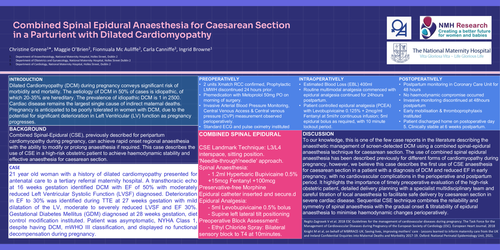
Dilated Cardiomyopathy (DCM) during pregnancy conveys significant risk of morbidity and mortality. The aetiology of DCM in 50% of cases is idiopathic, of which 20-35% are hereditary. The prevalence of idiopathic DCM is 1 in 2500. Cardiac disease remains the largest single cause of indirect maternal deaths. Pregnancy is anticipated to be poorly tolerated in women with DCM, due to the potential for significant deterioration in Left Ventricular (LV) function as pregnancy progresses.
BACKGROUND
Combined Spinal-Epidural (CSE), previously described for peripartum cardiomyopathy during pregnancy, can achieve rapid onset regional anaesthesia with the ability to modify or prolong anaesthesia if required. This case describes the use of CSE in a high-risk obstetric patient to achieve haemodynamic stability and effective anaesthesia for caesarean section.
CASE
21 year old woman with a history of dilated cardiomyopathy presented for antenatal care to a tertiary referral maternity hospital. A transthoracic echo at 16 weeks gestation identified DCM with EF of 50% with moderately reduced Left Ventricular Systolic Function (LVSF) diagnosed. Deterioration in EF to 30% was identified during TTE at 27 weeks gestation with mild dilatation of the LV, moderate to severely reduced LVSF and EF 30%. Gestational Diabetes Mellitus (GDM) diagnosed at 28 weeks gestation, diet control modification instituted. Patient was asymptomatic, NYHA Class 1, despite having DCM, mWHO III classification, and displayed no functional decompensation during pregnancy.
PREOPERATIVELY
INTRAOPERATIVELY
POSTOPERATIVELY
COMBINED SPINAL EPIDURAL
CSE Landmark Technique: L3/L4 interspace, sitting position.
'Needle-through'needle' approach.
Spinal Anaesthesia:
- 1.2ml Hyperbaric Bupivicaine 0.5% +15mcg Fentanyl +100mcg Preservative-free Morphine
Epidural catheter inserted and secure.d Epidural Analgesia:
- 5ml Levobupivicaine 0.5% bolus
- Supine left lateral tilt positioning Preoperative Block Assessment:
- Ethyl Chloride Spray: Bilateral sensory block to T4 at 10minutes.
DISCUSSION
To our knowledge, this is one of the few case reports in the literature describing the anaesthetic management of screen-detected DCM using a combined spinal-epidural anaesthesia technique for caesarean section. The use of combined spinal epidural anaesthesia has been described previously for different forms of cardiomyopathy during pregnancy, however, we believe this case describes the first use of CSE anaesthesia for caesarean section in a patient with a diagnosis of DCM and reduced EF in early pregnancy, with no cardiovascular complications in the perioperative and postpartum period. It highlights the importance of timely preoperative evaluation of the high-risk obstetric patient, detailed delivery planning with a specialist multidisciplinary team and careful titration of local anaesthesia to facilitate safe delivery by caesarean section in severe cardiac disease. Sequential CSE technique combines the reliability and symmetry of spinal anaesthesia with the gradual onset & titratability of epidural anaesthesia to minimise haemodynamic changes perioperatively.