191 posters, 5 topics, 20 sessions, 393 authors, 116 institutions
ePostersLive by SciGen Technologies S.A. All rights reserved.
Obstetric Anaesthesia Annual Scientific Meeting 2023
18 - 19 May, 2023 | EICC Edinburgh

5796104
Pseudo-successful lumbar puncture': Could it be a case of Tarlov's cyst?
Poster Presenter
Authors
Part of Topic
Case report
“Pseudo successful Lumbar puncture”: Could it be a case of Tarlov cyst?
Introduction:
The incidence of spinal anaesthetic failure in experienced hands is very low (<1%). While failure of spinal anaesthesia due to technique error, drug error and inexperience are commonly discussed; failure due to patient factors is often overlooked. There are no clear consensus guidelines on how this cohort of patients who have had a failed spinal anaesthetic should be followed up.
Case report:
We present a case of a 34-year-old, gravida 2 para 1 patient posted for an elective caesarean section. She had an uneventful caesarean section 13 years ago under spinal anaesthesia.
On this occasion, spinal anaesthesia was performed by an experienced anaesthetist using standard technique and dose but complete absence of block was noted after 15 minutes. Spinal anaesthetic was repeated in the same interspace. On both occasions, free flow of CSF and aspirate were confirmed, barbotage done and 2.5 ml 0.5% heavy bupivacaine with 300 mcg diamorphine given. Complete absence of block was noted and LSCS was performed under general anaesthesia. No anaesthetic complications were reported on routine follow up.
Discussion:
After a thorough review of literature, we formulated the following list of potential causes of a ‘pseudo successful lumbar puncture.’
Tarlov cyst:
P. A. Popham1 discussed the possibility of a failed spinal after epidural cysts, the most common of which are Tarlov cysts. With the increasing use of magnetic resonance imaging, these are estimated to be present in 4.5-9% of the adult population.
Tarlov cysts can be potentially dangerous and spinal anaesthesia is a relative contraindication. There are case reports of successful spinal blocks in patients with Tarlov cysts as well as patients having permanent neurological damage(1)
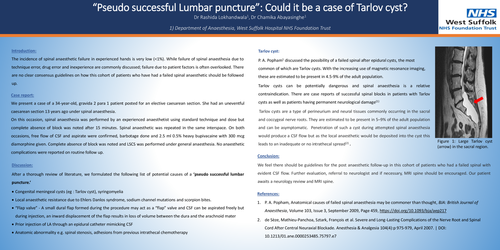
Tarlov cysts are a type of perineurium and neural tissues commonly occurring in the sacral and coccygeal nerve roots. They are estimated to be present in 5–9% of the adult population and can be asymptomatic. Penetration of such a cyst during attempted spinal anaesthesia would produce a CSF flow but as the local anaesthetic would be deposited into the cyst this leads to an inadequate or no intrathecal spread(2) .
Conclusion:
We feel there should be guidelines for the post anaesthetic follow-up in this cohort of patients who had a failed spinal with evident CSF flow. Further evaluation, referral to neurologist and if necessary, MRI spine should be encouraged. Our patient awaits a neurology review and MRI spine.
References: