191 posters, 5 topics, 20 sessions, 393 authors, 116 institutions
ePostersLive by SciGen Technologies S.A. All rights reserved.
Obstetric Anaesthesia Annual Scientific Meeting 2023
18 - 19 May, 2023 | EICC Edinburgh

5790838
Peripartum cardiomyopathy and hypermobility syndrome
Poster Presenter
Authors
Affiliations
Part of Topic
Case report
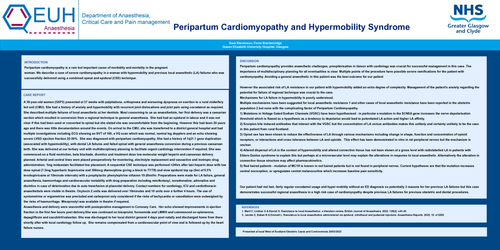
Peripartum Cardiomyopathy and Hypermobility Syndrome
Sara Stevenson, Fiona Breckenridge Queen Elizabeth University Hospital, Glasgow
INTRODUCTION
Peripartum cardiomyopathy is a rare but important cause of morbidity and mortality in the pregnant
woman. We describe a case of severe cardiomyopathy in a woman with hypermobility and previous local anaesthetic (LA) failures who was successfully delivered using a combined spinal and epidural (CSE) technique.
CASE REPORT
A 39-year-old women (G5P3) presented at 37 weeks with palpitations, orthopnoea and worsening dyspnoea on exertion to a rural midwifery led unit (CMU). She had a history of anxiety and hypermobility with recurrent joint dislocations and joint pain using cocodamol as required. She described multiple failures of local anaesthetic at her dentists. Most concerning to us as anaesthetists, her first delivery was a caesarian section which resulted in conversion from a regional technique to general anaesthesia. She had had an epidural in labour and it was not clear if this had been used or converted to spinal but she stated she was uncomfortable from the beginning. However this had been 20 years ago and there was little documentation around the events. On arrival to the CMU, she was transferred to a district general hospital and had multiple investigations including ECG showing an SVT of 160, a VQ scan which was normal, normal leg dopplers and an echo showing severe LVSD ejection fraction 25-30%. She was diagnosed with peripartum cardiomyopathy. She had a history of 1q21.1 gene duplication (associated with hypermobility), with dental LA failures and failed spinal with general anaesthesia conversion during a previous caesarean birth. She was delivered at our tertiary unit with multidisciplinary planning to facilitate urgent cardiology intervention if required. She was commenced on a fluid restriction, beta blockade, diuretics and treatment dose low molecular weight heparin and caesarean delivery planned. Arterial and central lines were placed preoperatively for monitoring, electrolyte replacement and vasoactive and inotropic drug administration; 1mg midazolam facilitated line placement. A sequential CSE technique was performed >24hrs after last heparin dose with low dose spinal (7.5mg hyperbaric bupivicaine and 300mcg diamorphine giving a block to T7/T8) and slow epidural top up (5ml of 0.5% levobupivicaine at 10minute intervals) with a prophylactic phenylephrine infusion 10-20ml/hr. Preparations were made for LA failure, general anaesthesia, haemorrhage and cardiovascular instability with drug preparation including remifentanyl, noradrenaline, adrenaline and diuretics in case of deterioration due to auto transfusion at placental delivery. Contact numbers for cardiology, ICU and cardiothoracic anaesthetists were visible in theatre. Oxytocin 2 units was delivered over 10minutes and 10 units over a further 4 hours. The use of syntometrine or ergometrine was precluded and carboprost only considered if the risks of tachycardia or vasodilation were outweighed by the risks of haemorrhage. Misoprostyl was available in theatre if required.
Anaesthesia and delivery were uneventful with postoperative management in Coronary Care. Her echo showed improvements in ejection fraction in the first few hours post delivery.She was continued on bisoprolol, furosemide and LMWH and commenced on eplenerone, dapagliflozin and sacubitril/valsartan. She was discharged to her local district general 4 days post natally and discharged home from there shortly after with local cardiology follow up. She remains compensated from a cardiovascular point of view and is followed up by the heart failure nurses.
DISCUSSION
Peripartum cardiomyopathy provides anaesthetic challenges; preoptimisation in liaison with cardiology was crucial for successful management in this case. The importance of multidisciplinary planning for all eventualities is clear. Multiple points of the procedure have possible severe ramifications for the patient with cardiomyopathy. Avoiding a general anaesthetic in this patient was the best outcome for our patient
However the associated risk of LA resistance in our patient with hypermobility added an extra degree of complexity. Management of the patient’s anxiety regarding the potential for failure of regional technique was crucial to the case.
Mechanisms for LA failure in hypermobility is poorly understood.
Multiple mechanisms have been suggested for local anasethetic resistance 1 and other cases of local anasethetic resistance have been reported in the obstetric population 2 but none with the complicating factor of Peripartum Cardiomyopathy.
1) Mutations in Voltage Gated Sodium Channels (VGSC) have been hypothesised - in particular a mutation in the SCN5A gene increases the nerve depolarisation threshold which is flawed as a hypothesis as a tendency to depolarise would lead to potentiated LA action and higher LA affinity.
2) Scorpion bite induced antibodies that interact with the VGSC but the concentration of LA versus antibodies makes this unlikely and certainly unlikely to be the case in this patient from rural Scotland.
3) Opiod use has been shown to reduce the effectiveness of LA through various mechanisms including change in shape, function and concentration of opioid receptors, or interactions and cross tolerance between LA and opioids. This effect has been demonstrated in vitro in rat peripheral nerves but the mechanism is unclear.
4) Altered dispersal of LA in the context of hypermobility and altered connective tissue has not been shown at a gross level with radiolabelled LA in patients with Ehlers-Danlos syndrome to explain this but perhaps at a microvascular level may explain the alterations in response to local anaesthetic. Alternatively the alteration in connective tissue structure may affect pharmacokinetics.
5) Red haired patients - mutation of MC1R is known in red haired patients but is not found in peripheral nerves. Current hypotheses are that the mutation increases central nociception, or upregulates central melanocortins which increases baseline pain sensitivity.
Our patient had red hair, fairly regular cocodamol usage and hyper mobility without an ED diagnosis so potentially 3 reasons for her previous LA failures but this case demonstrates successful regional anaesthesia in a high risk case of cardiomyopathy despite previous LA failures for previous obstetric and dental procedures.
REFERENCES
1. Marti F, Lindner G & Ravioli S. Resistance to local Anaesthetics: a literature review, British Journal of Anaesthesia. 2022; 129(2): e43-45
2. Jacobs E, Baban N & Emmett L. Resistance to local anaesthetics administered via epidural, intrathecal and pudendal injectons. Anaesthesia Reports. 2022; 10: e12205
Presented at local West of Scotland Obstetric Cases and Controversies 29/03/2023