90 posters, 5 videos, 1 audios, 6 topics, 3 sessions, 245 authors, 1 institutions
ePostersLive by SciGen Technologies S.A. All rights reserved.
Net Zero Clinical Care 2023
10 October 2023 | BMA House, London
30512
The Telemedicine Support Unit - a Single Point of Access to Hospital Eye Services
Poster Presenter
Authors
Affiliations
Part of Topic
The Telemedicine Support Unit - A Single Point of Access to Hospital Eye Services
Caroline L. S. Kilduff, Sejal Mistry, Claire Lovegrove & Peter B. M. Thomas, Moorfields Eye Hospital
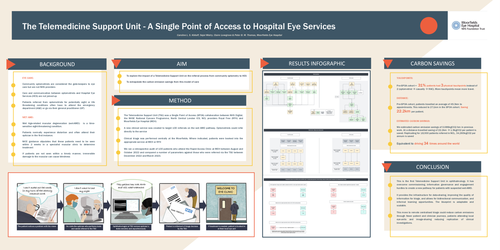
BACKGROUND:
EYE CARE:
Community optometrists are considered the gate-keepers to eye care but are not NHS providers
Care and communication between optometrists and Hospital Eye Services (HES) are not joined up
Patients referred from optometrists for potentially sight or life threatening conditions often have to attend the emergency department (A&E) or go via their general practitioner (GP)
WET AMD:
Wet Age-related macular degeneration (wet-AMD) is a time-sensitive sight-threatening condition.
Patients normally experience distortion and often attend their optician in the first instance.
NICE guidance stipulates that these patients need to be seen within 2 weeks in a specialist macular clinic to determine treatment
If patients are not seen within a timely manner, irreversible damage to the macular can cause blindness
AIM:
To explore the impact of a Telemedicine Support Unit on the referral process from community optometry to HES
To extrapolate the carbon emission savings from this model of care
METHODS:
The Telemedicine Support Unit (TSU) was a Single Point of Access (SPOA) collaboration between NHS Digital, the NHSE National Eyecare Programme, North Central London ICS, NCL providers Royal Free (RFH) and Moorfields Eye Hospital (MEH)
A new clinical service was created to target 100 referrals on the wet AMD pathway. Optometrists could refer directly to the service
Clinical triage was performed centrally at the Moorfields. Where indicated, patients were booked into the appropriate service at MEH or RFH
We ran a retrospective audit of 100 patients who attend the Rapid Access Clinic at MEH between August and October 2022 and compared a number of parameters against those who were referred via the TSU between December 2022 and March 2023.
RESULTS:
TOUCHPOINTS:
Pre-SPOA cohort = 31% patients had 3 physical touchpoints instead of 2 (optometrist à casualty à RAC). More touchpoints mean more travel.
DISTANCE:
Pre-SPOA cohort, patients travelled an average of 49.3km to appointments. This reduced to 27.1km in the SPOA cohort. Saving 22.2km per patient.
ESTIMATED CARBON SAVINGS:
We estimated carbon emission savings of 0.086kgCO2/km in previous work. At a distance travelled saving of 22.2km à 1.9kgCO2 per patient is saved. Replicating for 18,000 patients referred in NCL, 34,265kgCO2 per annum is saved
Equivalent to driving 34 times around the world
CONCLUSION:
This is the first Telemedicine Support Unit in ophthalmology. It has overcome commissioning, information governance and engagement hurdles to create a new pathway for patients with suspected wet-AMD.
It provides the infrastructure for data-sharing, improving the quality of information for triage, and allows for bidirectional communication, and informal learning opportunities. The blueprint is adaptable and scalable.
This move to remote centralised triage could reduce carbon emissions through fewer patient and clinician journeys, patients attending local eye-units and image-sharing reducing replication of clinical investigations.