90 posters, 5 videos, 1 audios, 6 topics, 3 sessions, 245 authors, 1 institutions
ePostersLive by SciGen Technologies S.A. All rights reserved.
Net Zero Clinical Care 2023
10 October 2023 | BMA House, London

30522
Potential carbon savings from changing surgical trends in primary elective total hip arthroplasty in England: A retrospective observational study.
Poster Presenter
Part of Topic
Low Carbon Care Pathways
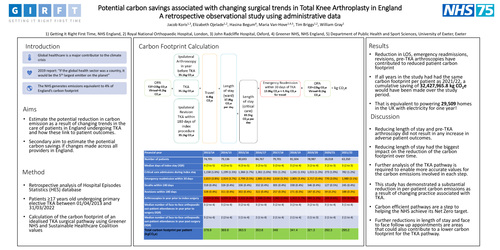
Potential carbon savings associated with changing surgical trends in Total Knee Arthroplasty in England
A retrospective observational study using administrative data
•Global healthcare is a major contributor to the climate crisis
•2019 report: “if the global health sector was a country, it would be the 5th largest emitter on the planet”
•The NHS generates emissions equivalent to 4% of England’s carbon footprint
•Estimate the potential reduction in carbon emission as a result of changing trends in the care of patients in England undergoing TKA and how these link to patient outcomes.
•Secondary aim to estimate the potential carbon savings if changes made across all providers in England.
•Retrospective analysis of Hospital Episodes Statistics (HES) database
•Patients ≥17 years old undergoing primary elective TKA between 01/04/2013 and 31/03/2022
•Calculation of the carbon footprint of an idealised TKA surgical pathway using Greener NHS and Sustainable Healthcare Coalition values
•Reduction in LOS, emergency readmissions, revisions, pre-TKA arthroscopies have contributed to reduced patient carbon footprint
•If all years in the study had had the same carbon footprint per patient as 2021/22, a cumulative saving of 32,427,965.8 kg CO2e would have been made over the study period.
•That is equivalent to powering 29,509 homes in the UK with electricity for one year!
•Reducing length of stay and pre-TKA arthroscopy did not result in any increase in adverse patient outcomes.
•Reducing length of stay had the biggest impact on the reduction of the carbon footprint over time.
•Further analysis of the TKA pathway is required to enable more accurate values for the carbon emissions involved in each step.
•This study has demonstrated a substantial reduction in per-patient carbon emissions as a result of changing practice associated with TKA.
•Carbon efficient pathways are a step to helping the NHS achieve its Net Zero target.
•Further reductions in length of stay and face to face follow up appointments are areas that could also contribute to a lower carbon footprint for the TKA pathway.