90 posters, 5 videos, 1 audios, 6 topics, 3 sessions, 245 authors, 1 institutions
ePostersLive by SciGen Technologies S.A. All rights reserved.
Net Zero Clinical Care 2023
10 October 2023 | BMA House, London

30513
Mapping carbon emissions at a granular level in an Ophthalmology AMD pathway
Poster Presenter
Part of Topic
Low Carbon Care Pathways
Mapping carbon emissions at a granular level in an Ophthalmology AMD pathway
Kavita Aggarwal1, Peter Davey2, Otiti Oboh1 , James Lorigan1 & Mandeep Bindra3
NHS England: 1Transformation Directorate 2Greener NHS, 3Buckinghamshire NHS Foundation Trust
Background
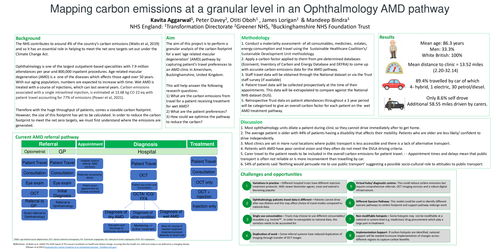
The NHS contributes to around 4% of the country’s carbon emissions (Watts et al, 2019) and so it has an essential role in helping to meet the net zero targets set out under the Climate Change Act. Ophthalmology is one of the largest outpatient-based specialities with 7.9 million attendances per year and 800,000 inpatient procedures. Age-related macular degeneration (AMD) is a one of the diseases which affects those aged over 50 years. With our aging population, numbers are expected to increase with time. Wet AMD is treated with a course of injections, which can last several years. Carbon emissions associated with a single intravitreal injection, is estimated at 13.68 kg CO 22 eq with patient travel accounting for 77% of emissions (Power et al, 2021). Therefore with the huge throughput of patients, comes a sizeable carbon footprint. However, the size of this footprint has yet to be calculated. In order to reduce the carbon footprint to meet the net zero targets, we must first understand where the emissions are generated.
Aim
The aim of this project is to perform a granular analysis of the carbon footprint for a wet ‘age related macular degeneration’ (AMD) pathway by capturing patient’s travel preferences to an AMD clinic in Amersham, Buckinghamshire, United Kingdom.
This will help answer the following research questions:
1) What are the carbon emissions from travel for a patient receiving treatment for wet AMD?
2) What are the patient preferences?
3) How could we optimise the pathway to reduce the carbon?
Methodology
1. Conduct a materiality assessment- of all consumables, medicines, estates, energy consumption and travel using the Sustainable Healthcare Coalition’s/ Sustainable Development Unit methodology.
2. Apply a carbon factor applied to them from pre-determined databases (Ecoinvent, Inventory of Carbon and Energy Database and DEFRA) to come up with accurate carbon emissions data for the AMD pathway.
3. Staff travel data will be obtained through the National dataset or via the Trust staff survey (if available)
4. Patient travel data will be collected prospectively at the time of their appointments. This data will be extrapolated to compare against the National NHS dataset (SUS).
5. Retrospective Trust data on patient attendances throughout a 3 year period will be categorised to give an overall carbon factor for each patient on the wet AMD treatment pathway.
Discussion
1. Most ophthalmology units dilate a patient during clinic so they cannot drive immediately after to get home.
2. The average patient is older with 44% of patients having a disability that affects their mobility. Patients who are older are less likely/ confident to drive independently.
3. Most clinics are set in more rural locations where public transport is less accessible and there is a lack of alternative transport.
4. Patients with AMD have poor central vision and they often do not meet the DVLA driving criteria.
5. Carer travel to the patient needs to be included in the overall carbon emissions for patient travel. - - Appointment times and delays mean that public transport is often not reliable or is more inconvenient than travelling by car.
6. 54% of patients said ‘Nothing would persuade me to use public transport’ suggesting a possible socio-cultural role to attitudes to public transport.