90 posters, 5 videos, 1 audios, 6 topics, 3 sessions, 245 authors, 1 institutions
ePostersLive by SciGen Technologies S.A. All rights reserved.
Net Zero Clinical Care 2023
10 October 2023 | BMA House, London
31195
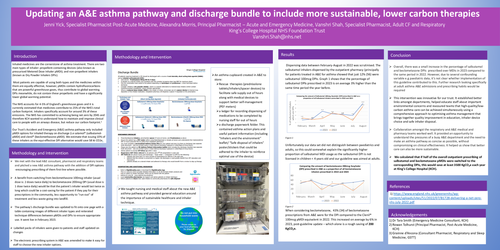
Updating an A&E asthma pathway and discharge bundle to include more sustainable, lower-carbon therapies
Poster Presenter
Part of Topic
Low Carbon Care Pathways
Inhaled medicines are the cornerstone of asthma treatment. There are two main types of inhaler: propellent-containing devices (also known as pressurised Metered Dose Inhaler pMDI); and non-propellent inhalers (known as Dry Powder Inhalers DPIs).
Most patients are capable of using both types and the medicines within them are equally effective, however, pMDIs contain hydrofluorocarbons that are powerful greenhouse gases, thus contribute to global warming. DPIs meanwhile, do not contain these propellants and have a significantly lower global warming potential.
The NHS accounts for 4-5% of England’s greenhouse gases and it is currently estimated that medicines contribute to 25% of the NHS’s total carbon footprint. Inhalers specifically account for around 3% of these emissions. The NHS has committed to achieving being net zero by 2045 and therefore KCH wanted to understand how to maintain and improve clinical care to people with an airways disease, but reduce our carbon footprint.1
Our Trust’s Accident and Emergency (A&E) asthma pathway only included pMDI options for inhaled therapy on discharge (i.e salamol® (salbutamol- pMDI) and clenil® (beclomethasone pMDI). We estimate that issuing 10% of these inhalers as the equi-effective DPI alternative would save 58 kt CO2e.