90 posters, 5 videos, 1 audios, 6 topics, 3 sessions, 245 authors, 1 institutions
ePostersLive by SciGen Technologies S.A. All rights reserved.
Net Zero Clinical Care 2023
10 October 2023 | BMA House, London

31194
Life Cycle Analysis of the Carbon Footprint of Birth Highlights Key Areas for Reduction of its Environmental Impact
Poster Presenter
Part of Topic
Low Carbon Care Pathways
Audio
Background
• One of the most commonly occurring health events is birth (~140M births/year). However, research on the environmental impact of mode of birth is limited.
• One means to reduce the carbon footprint is to reduce unnecessary interventions and procedures and to reduce the carbon footprint of necessary care.
• Given the frequency of birth, reducing its environmental impact and reducing unnecessary procedures should be an important goal for maternity services around the world. To reduce the carbon footprint of birth it is critical to understand which factors contribute to its environmental impact.
• This study aimed to calculate the carbon footprint of a vaginal birth in both hospital and home settings and for Caesarean section. We were also interested in the influence of analgesia since Entonox (the most commonly used analgesic for labour) has a high carbon footprint.
Methods
A life cycle assessment, including: equipment use, energy, analgesia, hospital stay, waste, sterilisation and laundry, was conducted using primary data combined with data from published sources.
Results
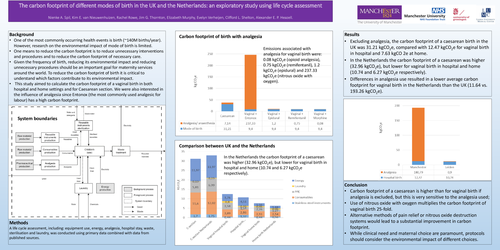
• Excluding analgesia, the carbon footprint of a caesarean birth in the UK was 31.21 kgCO2e, compared with 12.47 kgCO2e for vaginal birth in hospital and 7.63 kgCO2e at home.
• In the Netherlands the carbon footprint of a caesarean was higher (32.96 kgCO2e), but lower for vaginal birth in hospital and home (10.74 and 6.27 kgCO2e respectively).
• Differences in analgesia use resulted in a lower average carbon footprint for vaginal birth in the Netherlands than the UK (11.64 vs. 193.26 kgCO2e).
Conclusion
• Carbon footprint of a caesarean is higher than for vaginal birth if analgesia is excluded, but this is very sensitive to the analgesia used;
• Use of nitrous oxide with oxygen multiplies the carbon footprint of vaginal birth 25-fold.
• Alternative methods of pain relief or nitrous oxide destruction systems would lead to a substantial improvement in carbon footprint.
While clinical need and maternal choice are paramount, protocols should consider the environmental impact of different choices