90 posters, 5 videos, 1 audios, 6 topics, 3 sessions, 245 authors, 1 institutions
ePostersLive by SciGen Technologies S.A. All rights reserved.
Net Zero Clinical Care 2023
10 October 2023 | BMA House, London

30576
Greener Practice’s High Quality and Low Carbon Asthma Care Quality Improvement Toolkit
Poster Presenter
Authors
Part of Topic
Low Carbon Care Pathways
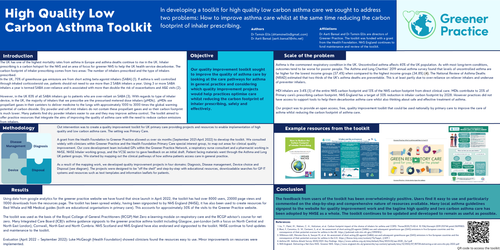
High Quality Low Carbon Asthma Toolkit. In developing a toolkit for high quality low carbon asthma care we sought to address two problems: How to improve asthma care whilst at the same time reducing the carbon footprint of inhaler prescribing.
The UK has one of the highest mortality rates from asthma in Europe and asthma deaths continue to rise in the UK. Inhaler prescribing is a carbon hotspot for the NHS and an area of focus for greener NHS to help the UK health service decarbonise. The carbon footprint of inhaler prescribing comes from two areas: The number of inhalers prescribed and the type of inhalers prescribed.
In the UK, 70% of greenhouse gas emissions are from short acting beta agonist inhalers (SABA) (1). If asthma is well controlled through inhaled corticosteroid use, patients should not need to use more than 2 SABA inhalers a year. Using 3 or more SABA inhalers a year is termed SABA over-reliance and is associated with more than double the risk of exacerbations and A&E visits (2).
However, in the UK 83% of all SABA inhalers go to patients who are over-reliant on SABA (3). With regards to type of inhaler device, in the UK, the majority of inhalers that we prescribe are the pressurised metered dose inhalers (pMDIs).pMDIs use propellant gases in their canisters to deliver medicine to the lungs with approximately 1000 to 3000 times the global warming potential of carbon dioxide. Dry powder and soft mist inhalers do not contain these propellant gases and so their carbon footprint is much lower. Many patients find dry powder inhalers easier to use and they may improve asthma control. The toolkit aimed to offer practice resources that integrate the aims of improving the quality of asthma care with the need to reduce carbon emissions from inhalers.
Our quality improvement toolkit sought to improve the quality of asthma care by looking at the care pathways for asthma in general practice and considering which quality improvement projects would help practices optimise care whilst reducing the carbon footprint of inhaler prescribing, safely and effectively.
Asthma is the commonest respiratory condition in the UK. Uncontrolled asthma affects 40% of the UK population. As with most long-term conditions, outcomes tend to be worse for poorer people. The Asthma and Lung Charities’ 2019 annual asthma survey found that levels of uncontrolled asthma are far higher for the lowest income groups (57.4%) when compared to the highest income groups (34.8%) (4). The National Review of Asthma Deaths (NRAD) estimated that two thirds of the UK’s asthma deaths are preventable. This is at least partly due to over-reliance on reliever inhalers and underuse of preventer inhalers.
Using data from google analytics for the greener practice website we have found that since launch in April 2022, the toolkit has had over 8000 users, 23000 page views and 11000 downloads from the resources page. The toolkit has been spread widely, having been signposted to by NHS England (NHSE), it has also been used to create resources for Red Whale and NB Medical guides (both are educational organisations in primary care). This accounts for approximately 50% of the visits to the Greener Practice website.
The toolkit was used as the basis of the Royal College of General Practitioners (RCGP) Net Zero e-learning module on respiratory care and the RCGP advisor’s course for net zero. Many Integrated Care Board (ICB)'s asthma guidance signposts to the greener practice asthma toolkit including Glasgow, pan-London (with a focus on North Central and North East London), Cornwall, North East and North Cumbria. NHS Scotland and NHS England have also endorsed and signposted to the toolkit. NHSE continue to fund updates and maintenance to the toolkit.
Evaluation (April 2022 – September 2022): Luke McGeogh (Health Foundation) showed clinicians found the resources easy to use. Minor improvements on resources were implemented.
The feedback from users of the toolkit has been overwhelmingly positive. Users find it easy to use and particularly commented on the step-by-step and comprehensive nature of resources available. Many local asthma guidelines signpost to the website for quality improvement work and the tagline high quality and lwo carbon asthma care has been adopted by NHSE as a whole. The toolkit continues to be updated and developed to remain as useful as possible.
MDI inhalers are 3-4% (5) of the entire NHS carbon footprint and 13% of the NHS carbon footprint from direct clinical care. MDIs contribute to 25% of Primary care's prescribing carbon footprint. NHS England has a target of 50% reduction in inhaler carbon footprint by 2028. However practices did not have access to support tools to help them decarbonise asthma care whilst also thinking about safe and effective treatment of asthma.
Our project was to provide an open access, free, quality improvement toolkit that could be used nationally by primary care to improve the care of asthma whilst reducing the carbon footprint of asthma care.