90 posters, 5 videos, 1 audios, 6 topics, 3 sessions, 245 authors, 1 institutions
ePostersLive by SciGen Technologies S.A. All rights reserved.
Net Zero Clinical Care 2023
10 October 2023 | BMA House, London

30543
Evaluation of a primary eyecare glaucoma service (PEGS) pilot
Poster Presenter
Authors
Part of Topic
Low Carbon Care Pathways
Mixed methods evaluation of the Manchester Primary Eyecare Glaucoma Service (PEGS)
Background and objective
Over half a million people in the UK are affected by glaucoma, with monitoring and treatment for this condition accounting for approximately 20% of all Hospital Eye Service (HES) appointments. It is predicted the number of patients with glaucoma will increase by 44% in the next 20 years. The existing backlog has been further exacerbated by the COVID-19 pandemic. Together, these pressures lead to capacity issues and delays in appointments, potentially a cause of avoidable and irreversible visual loss. UK HES glaucoma services are increasingly dependent upon non-medical professionals (NMPs) for shared care, although the use of shared care for glaucoma outside of secondary care/HES and within primary care is less common. Recently Manchester Royal Eye Hospital (MREH) developed Primary Eyecare Glaucoma Service (PEGS), with primary care optometrists reviewing low risk patients, reducing the burden in secondary care, and creating capacity for higher-risk patients. In this pilot study our objective was to assess the safety, efficacy, and stakeholder satisfaction with a Primary Eye Glaucoma Service (PEGS), with low-risk glaucoma patients being reviewed within primary care optometry, and to determine the impact of the service on carbon emissions.
Methods
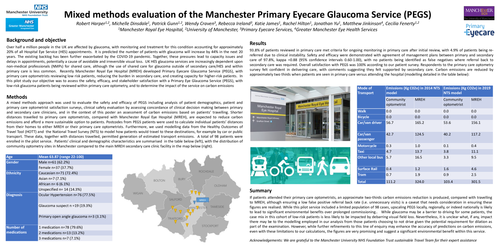
A mixed methods approach was used to evaluate the safety and efficacy of PEGS including analysis of patient demographics, patient and primary care optometrist satisfaction surveys, clinical safety evaluation by assessing concordance of clinical decision making between primary and secondary care clinicians, and in the context of this poster an assessment of carbon emissions based on patients’ travelling. Shorter distances travelled to primary care optometrists, compared with Manchester Royal Eye Hospital (MREH), are expected to reduce carbon emissions and afford a more sustainable option to patients. Postcodes from PEGS patients were used to calculate individual patients’ distances from their homes to either MREH or their primary care optometrists. Furthermore, we used modelling data from the Healthy Outcomes of Travel Tool (HOTT) and the National Travel Survey (NTS) to model how patients would travel to these destinations, for example by car or public transport. These data, together with distances travelled, permitted generation of estimated transport emissions. A total of 98 patients were enrolled in the pilot service. Patients’ clinical and demographic characteristics are summarised in the table below (left), with the distribution of community optometry sites in Manchester compared to the main MREH secondary care clinic facility in the map below (right).
Results
93.8% of patients reviewed in primary care met criteria for ongoing monitoring in primary care after initial review, with 4.9% of patients being re-referred due to clinical instability. Safety and efficacy were demonstrated with agreement of management plans between primary and secondary care of 97.8%, kappa =0.88 (95% confidence intervals 0.60-1.00), with no patients being identified as false negatives where referral back to secondary care was required. Overall satisfaction with PEGS was 100% according to our patient survey. Respondents to the primary care optometry survey felt confident in delivering care, with comments suggesting they felt supported by secondary care. Carbon emissions are reduced by approximately two thirds when patients are seen in primary care versus attending the hospital (modelling detailed in the table below):
Summary
If patients attended their primary care optometrists, an approximate two-thirds carbon emissions reduction is produced, compared with travelling to MREH, although ensuring a low false positive referral back rate (i.e. unnecessary visits) is a caveat that needs consideration in ensuring these figures are realised. While this pilot service included a limited population of 98 cases, upscaling PEGS locally, regionally, or indeed nationally is likely to lead to significant environmental benefits over prolonged commissioning.. While glaucoma may be a barrier to driving for some patients, the case mix in this cohort of low-risk patients is less likely to be impacted by debarring visual field loss. Nevertheless, it is unclear what, if any, impact there may be to the modelling employed in our analysis from those patients choosing to not drive given the potential requirement for dilation as part of the examination. However, while further refinements to this line of enquiry may enhance the accuracy of predictions on carbon emissions, even with these limitations to our calculations, the figures are very promising and suggest a significant environmental benefit within this service.