90 posters, 5 videos, 1 audios, 6 topics, 3 sessions, 245 authors, 1 institutions
ePostersLive by SciGen Technologies S.A. All rights reserved.
Net Zero Clinical Care 2023
10 October 2023 | BMA House, London

30528
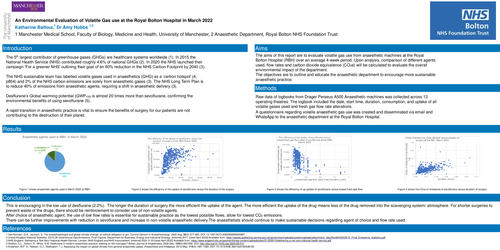
An Environmental Evaluation of Volatile Gas use at the Royal Bolton Hospital in March 2022
Poster Presenter
Authors
Part of Topic
Low Carbon Care Pathways
An Environmental Evaluation of Volatile Gas use at the Royal Bolton Hospital in March 2022
Katharine Balfour,1 Dr Amy Hobbs 1,2
1 Manchester Medical School, Faculty of Biology, Medicine and Health, University of Manchester, 2 Anaesthetic Department, Royal Bolton NHS Foundation Trust
Introduction
The 5th largest contributor of greenhouse gases (GHGs) are healthcare systems worldwide (1). In 2015 the National Health Service (NHS) contributed roughly 4.6% of national GHGs (2). In 2020 the NHS launched their campaign ‘For a greener NHS’ outlining their goal of an 80% reduction in the NHS Carbon Footprint by 2040 (3).
The NHS sustainable team has labelled volatile gases used in anaesthetics (GHG) as a ‘carbon hotspot’ (4, p854) and 2% of the NHS carbon emissions are solely from anaesthetic gases (3). The NHS Long Term Plan is to reduce 40% of emissions from anaesthetic agents, requiring a shift in anaesthetic delivery (3).
Desflurane’s Global warming potential (GWP100) is almost 20 times more than sevoflurane, confirming the environmental benefits of using sevoflurane (5).
A rapid transition in anaesthetic practice is vital to ensure the benefits of surgery for our patients are not contributing to the destruction of their planet.
Aims
The aims of this report are to evaluate volatile gas use from anaesthetic machines at the Royal Bolton Hospital (RBH) over an average 4-week period. Upon analysis, comparison of different agents used, flow rates and carbon dioxide equivalence (CO2e) will be calculated to evaluate the overall environmental impact of the department.
The objectives are to outline and educate the anaesthetic department to encourage more sustainable anaesthetic practice.
Methods
Raw data of logbooks from Drager Perseus A500 Anaesthetic machines was collected across 13 operating theatres. The logbook included the date, start time, duration, consumption, and uptake of all volatile gases used and fresh gas flow rate alterations.
A questionnaire regarding volatile anaesthetic gas use was created and disseminated via email and WhatsApp to the anaesthetic department at the Royal Bolton Hospital.
Results - See Figures on Poster
Conclusion
This is encouraging in the low use of desflurane (2.2%). The longer the duration of surgery the more efficient the uptake of the agent. The more efficient the uptake of the drug means less of the drug removed into the scavenging system/ atmosphere. For shorter surgeries to prevent waste of the drugs, there should be reinforcement to consider use of non-volatile agents.
After choice of anaesthetic agent, the use of low flow rates is essential for sustainable practice as the lowest possible flows, allow for lowest CO2 emissions.
There can be further improvements with reduction in sevoflurane and increase in non-volatile anaesthetic delivery.The anaesthetists should continue to make sustainable decisions regarding agent of choice and flow rate used.
References
1 Van Norman, G.A., Jackson, S. The anaesthesiologist and global climate change: an ethical obligation to act. Current Opinion in Anaesthesiology. 2020 Aug; 33(4):577-583. DOI: 10.1097/ACO.0000000000000887
2 United Kingdom National Statistics. 2015 UK Greenhouse Gas Emissions, Final Figures. Department for Business, Energy and Industrial Strategy. [Internet] 2017. [cited April 2022] Available from: https://assets.publishing.service.gov.uk/government/uploads/system/uploads/attachment_data/file/604350/2015_Final_Emissions_statistics.pdf
3 NHS England. Delivering a ‘Net Zero’ National Health Service. London: NHS England and NHS Improvement. [Internet] 2020: 5-33 [cited April 2022] Available from: https://www.england.nhs.uk/greenernhs/wp-content/uploads/sites/51/2020/10/delivering-a-net-zero-national-health-service.pdf
4 Shelton, C.L., Sutton, R., White, S.M. Desflurane in modern anaesthetic practice: walking on thin ice(caps)? British Journal of Anaesthesia. 2020 Dec; 125(6):852-856. DOI: http://doi.org/10.1016/j.bja.2020.09.013
5 Anderson, M.P. S., Neilsen, O.J., Wallington, T.J. Assessing the impact on global climate from general anaesthetic gases. Anaesthesia and Analgesia. 2012 May; 114(5):1081-1085. DOI: 10.1213/ANE.0b013e31824d6150