90 posters, 5 videos, 1 audios, 6 topics, 3 sessions, 245 authors, 1 institutions
ePostersLive by SciGen Technologies S.A. All rights reserved.
Net Zero Clinical Care 2023
10 October 2023 | BMA House, London

30510
The Impact of Emergency Ophthalmic Remote Consultations on Patient Finances, Time, and Carbon Footprint
Poster Presenter
Part of Topic
Low Carbon Care Settings
The Impact of Emergency Ophthalmic Remote Consultations on Patient Finances, Time, and Carbon Footprint
Caroline L. S. Kilduff, Rishi Ramessur, Alice A. P. Thomas,, Anton Jaselsky, Gordon Hay, Peter B. M. Thomas – Moorfields Eye Hospital
BACKGROUND:
Climate change associated with Greenhouse Gas Emissions (GHGE) is the biggest global public health threat of the 21st Century
Transport is the largest contributor of UK GHGE
Transport accounts for 18% of NHS emissions.
Prior to Covid-19, video-consultations were not routinely performed in eye care due to perceived dependence on examination equipment
AIM:
To explore the impact of ophthalmic video-consultations on patient finances, time and carbon footprint.
METHOD:
Moorfields Eye Hospital (MEH) set up an emergency eye triage video-consultation (VC) service
Time, cost, distance and carbon dioxide (CO2) emissions saved through this video-triage service were calculated from a single weekday snapshot of patients using the service, instead of attending the walk-in eye casualty
Additionally, 3182 patients were asked to estimate these savings via an online questionnaire
Historic attendance figures were used to extrapolate annual estimates for comparative time, cost and CO2 emissions
RESULTS:
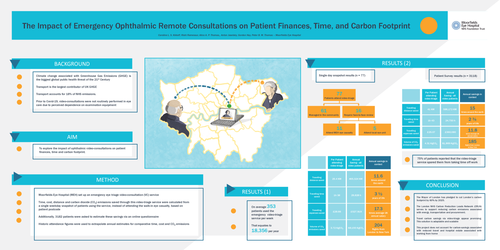
On average 353 patients used the emergency video-triage service per week
Single day snapshot: 77 patients used video-triage service - 61/77 patients were managed in the community. 16/77 rrequired face-to-face review.
Table 1: Estimates for travel savings due to video-triage based on the single-day snapshot
Table 2: Estimates for travel savings due to video-triage based on the 3118 completed survey responses
75% of patients reported that the video-triage service spared them from having to take time off work
CONCLUSION:
The Mayor of London has pledged to cut London’s carbon footprint by 60% by 2025.
The London NHS Carbon Reduction Leads Network (CRLN) serves to support reducing carbon emissions associated with energy, transportation and procurement.
Travel carbon savings via video-triage appear promising. This solution is adaptable and scalable
This project does not account for carbon-savings associated with reduced travel and hospital estate associated with working from home