586 posters, 8 topics, 23 sessions, 1,077 authors, 622 institutions
ePostersLive by SciGen Technologies S.A. All rights reserved.
ISQua's 40th International Conference 2024
24th - 27th September 2024 | Istanbul, Türkiye

P698
Situational analysis of the health system in war-torn Sana'a city in Yemen: a literature review
Poster Presenter
Part of Topic
Equity in Action: Addressing Global Healthcare Emergencies
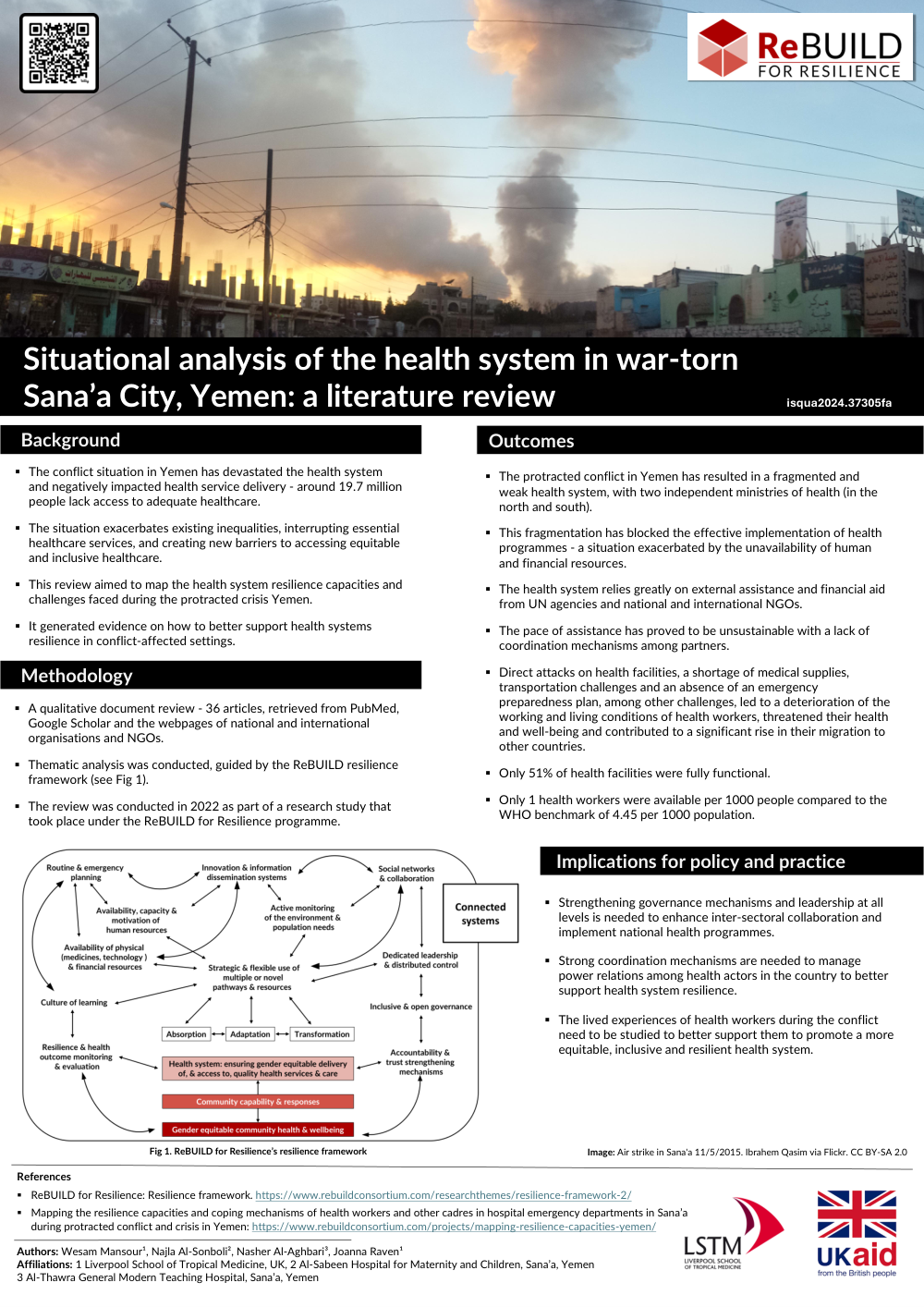
Situational analysis of the health system in war-torn Sana’a City, Yemen: a literature review
Background:
The conflict situation in Yemen has devastated the health system and negatively impacted health service delivery - around 19.7 million people lack access to adequate healthcare.
The situation exacerbates existing inequalities, interrupting essential healthcare services, and creating new barriers to accessing equitable and inclusive healthcare.
This review aimed to map the health system resilience capacities and challenges faced during the protracted crisis Yemen.
It generated evidence on how to better support health systems resilience in conflict-affected settings.
Methodology:
A qualitative document review - 36 articles, retrieved from PubMed, Google Scholar and the webpages of national and international organisations and NGOs.
Thematic analysis was conducted, guided by the ReBUILD resilience framework (see Fig 1).
The review was conducted in 2022 as part of a research study that took place under the ReBUILD for Resilience programme.
Outcomes:
The protracted conflict in Yemen has resulted in a fragmented and weak health system, with two independent ministries of health (in the north and south).
This fragmentation has blocked the effective implementation of health programmes - a situation exacerbated by the unavailability of human and financial resources.
The health system relies greatly on external assistance and financial aid from UN agencies and national and international NGOs.
The pace of assistance has proved to be unsustainable with a lack of coordination mechanisms among partners.
Direct attacks on health facilities, a shortage of medical supplies, transportation challenges and an absence of an emergency preparedness plan, among other challenges, led to a deterioration of the working and living conditions of health workers, threatened their health and well-being and contributed to a significant rise in their migration to other countries.
Only 51% of health facilities were fully functional.
Only 1 health workers were available per 1000 people compared to the WHO benchmark of 4.45 per 1000 population.
Implications for policy and practice:
Strengthening governance mechanisms and leadership at all levels is needed to enhance inter-sectoral collaboration and implement national health programmes.
Strong coordination mechanisms are needed to manage power relations among health actors in the country to better support health system resilience.
The lived experiences of health workers during the conflict need to be studied to better support them to promote a more equitable, inclusive and resilient health system.