586 posters, 8 topics, 23 sessions, 1,077 authors, 622 institutions
ePostersLive by SciGen Technologies S.A. All rights reserved.
ISQua's 40th International Conference 2024
24th - 27th September 2024 | Istanbul, Türkiye

P685
Assessing the public-private partnership in improving the quality of primary care services in Indonesia
Poster Presenter
Authors
Affiliations
Part of Topic
Equity in Action: Addressing Global Healthcare Emergencies
Assessing the Public Private Partnership in Improving the Quality of Primary Care Service in Indonesia
Eva Tirtabayu Hasri1, Stevie Ardianto Nappoe1, Andriani Yulianti1, Hanevi Djasri1
1 Centre for Health Policy and Management, Faculty of Medicine-Public Health and Nursing Gadjah Mada of University
INTRODUCTION
Primary Health Care services are essential in supporting the Universal Health Coverage (UHC). Not only to ensure the gatekeeping function to prevent burning out in secondary care but also to ensure the highest community health status is achieved. Indonesia has introduced the National Health Insurance program as part of the UHC journey since 2014. Yet, the problem with primary care still exists with public providers becoming the main party who provide most of the services compared to private providers. However, disparities in the quality of services are prominently displayed with better preferences for private providers. All these problems will potentially delay the achievement of UHC as well as widen the equity and quality gap moving forward.
AIM
The objective of this study is to understand the problem of public-private partnerships in primary care providers in National Health Insurance (NHI) in Indonesia.
METHOD
This research is a qualitative study, conducted in two regions (Cimahi, West Java, and Badung, Bali) in 2021. Representatives from 4 Puskesmas as a public provider and their service network including general practitioners and clinics as private providers were invited for focus group discussions about their experience in collaboration, existing problems with partnership, and expectations for the integrated model. Thematic analyses were used to understand the phenomenon and draw conclusions about the problem as well as solutions.
RESULTS
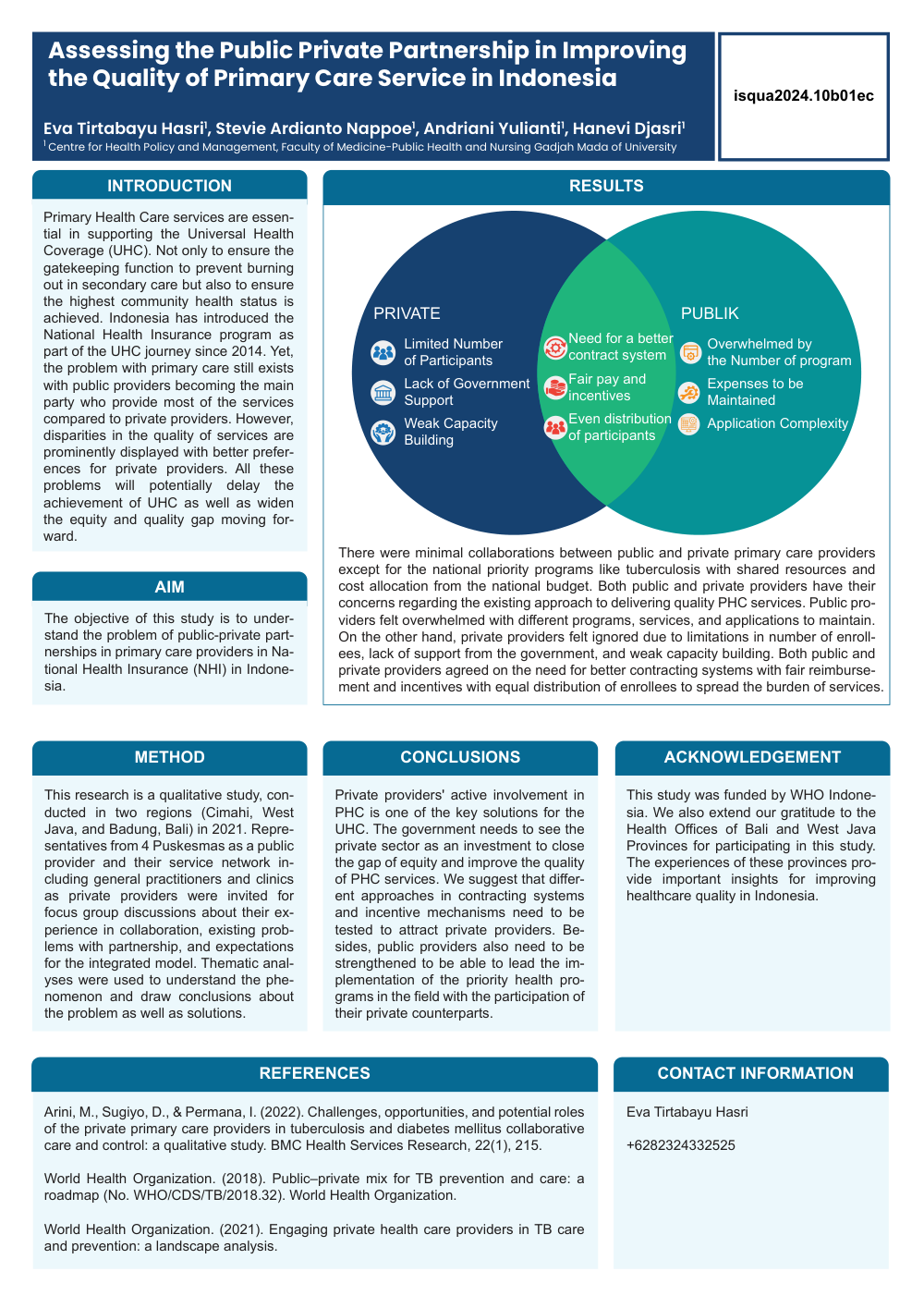
There were minimal collaborations between public and private primary care providers except for the national priority programs like tuberculosis with shared resources and cost allocation from the national budget. Both public and private providers have their concerns regarding the existing approach to delivering quality PHC services. Public providers felt overwhelmed with different programs, services, and applications to maintain. On the other hand, private providers felt ignored due to limitations in number of enrollees, lack of support from the government, and weak capacity building. Both public and private providers agreed on the need for better contracting systems with fair reimbursement and incentives with equal distribution of enrollees to spread the burden of services.
CONCLUSIONS
Private providers' active involvement in PHC is one of the key solutions for the UHC. The the participation of their private counterparts. government needs to see the private sector as an investment to close the gap of equity and improve the quality of PHC services. We suggest that different approaches in contracting systems and incentive mechanisms need to be tested to attract private providers. Besides, public providers also need to be strengthened to be able to lead the implementation of the priority health programs in the field with the participation of their private counterparts.
ACKNOWLEDGEMENT
This study was funded by WHO Indonesia. We also extend our gratitude to the Health Offices of Bali and West Java Provinces for participating in this study. The experiences of these provinces provide important insights for improving healthcare quality in Indonesia.
REFERENCES
Arini, M., Sugiyo, D., & Permana, I. (2022). Challenges, opportunities, and potential roles
of the private primary care providers in tuberculosis and diabetes mellitus collaborative
care and control: a qualitative study. BMC Health Services Research, 22(1), 215.
World Health Organization. (2018). Public–private mix for TB prevention and care: a
roadmap (No. WHO/CDS/TB/2018.32). World Health Organization.
World Health Organization. (2021). Engaging private health care providers in TB care
and prevention: a landscape analysis.
CONTACT INFORMATION
Eva Tirtabayu Hasri
+6282324332525